
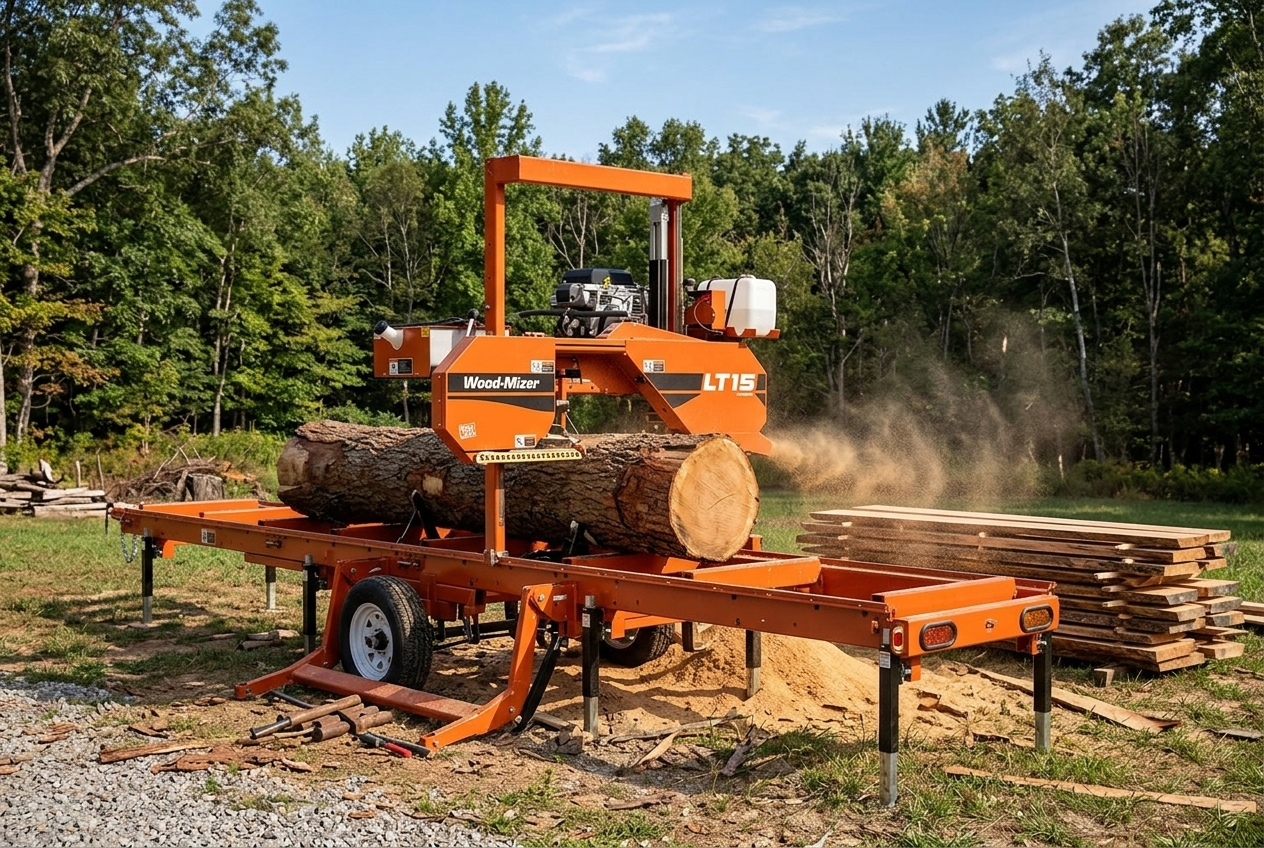
A portable sawmill is a compact, transportable machine that cuts logs into lumber right where the log fell — most commonly a thin-kerf bandsaw mill, but also chainsaw (Alaskan) mills and swing-blade mills. Prices run from about $300 for a chainsaw mill to $40,000-plus for a full hydraulic production mill, and the right one depends almost entirely on how much wood you plan to cut and whether you’re doing it for a hobby or a paycheck.
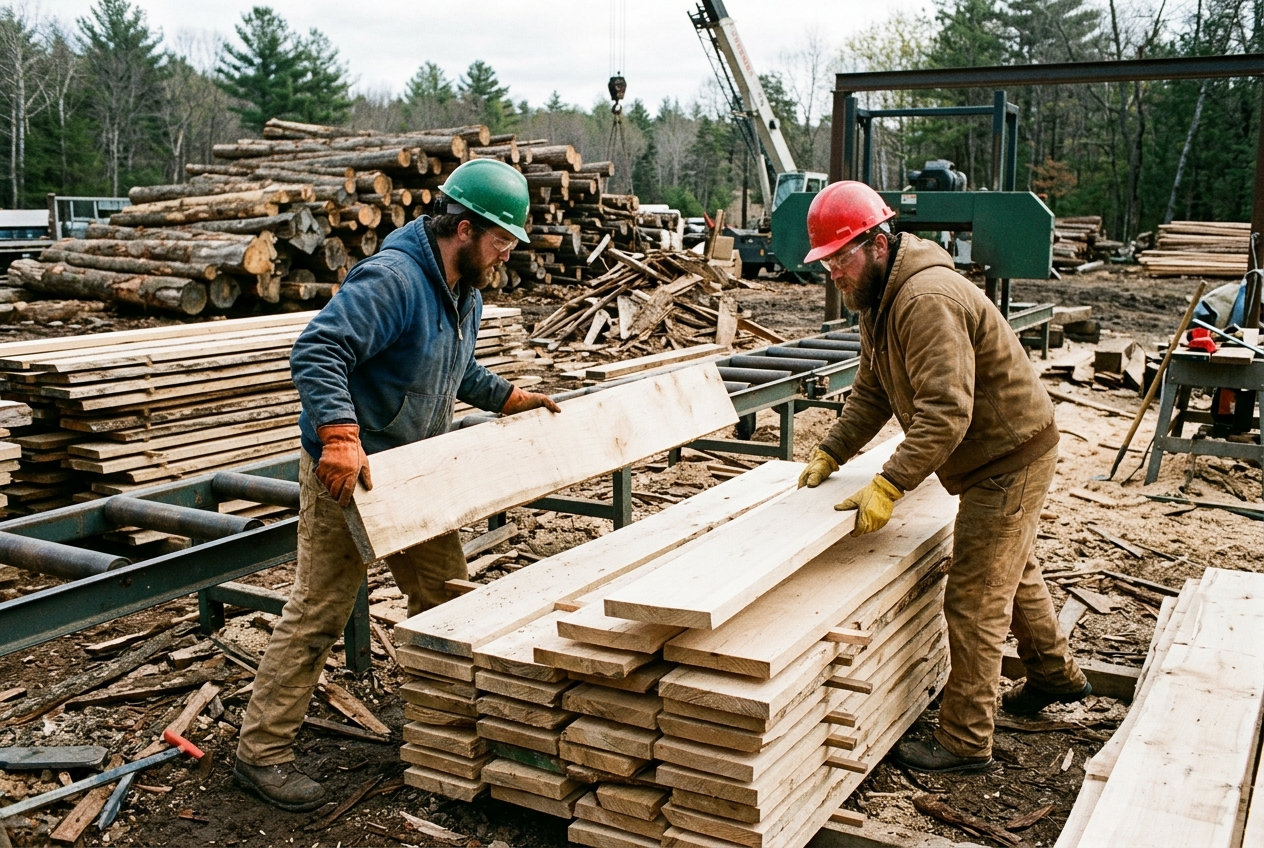
That’s the short version. If you’re standing in your yard looking at a pile of storm-dropped oak, or you’re weighing whether a mill can pay for itself, this guide is the long version — written by people who actually run these machines. At The Cut Side we mill upper-Midwest hardwoods on a Wood-Mizer LT15, and between Jason, Franklin, and Dave we’ve made just about every buying mistake there is. This is the guide we wish we’d had before we spent the money.
We’ll cover what a portable sawmill actually is, the three types and when each makes sense, the manual-versus-hydraulic decision that trips up most first-time buyers, real 2026 pricing by tier, and a straight answer to the question everyone eventually asks: can you make money with one?
Quick Answer: A portable sawmill turns logs into finished lumber right where the tree falls. Most buyers should get a bandsaw mill — hobby-grade units run about $3,000–$8,000, while hydraulic production mills start near $30,000. Chainsaw (Alaskan) mills are the cheapest way in at $200–$1,000 but are slow for real volume.
Last Updated: July 2026 · By Jason Lewis, who runs a Wood-Mizer LT15 milling upper-Midwest hardwoods at The Cut Side. The guidance below comes from time behind the mill, not spec sheets.
The Cut Side may earn a commission from some links on this page at no extra cost to you — we only point to gear we’d actually run ourselves.
What Is a Portable Sawmill?
A portable sawmill is a machine that turns whole logs into dimensional lumber and slabs on-site, without hauling logs to a commercial mill. Instead of the log going to the saw, the saw goes to the log. On the most common type — a bandsaw mill — a thin steel band blade spins on two wheels and is carried through the log along a level track (the “bed”). You raise or lower the sawhead for each board’s thickness, push it through, drop it down, and cut again. What comes off is usable lumber: 1-inch boards, 2-by framing stock, beams, or wide live-edge slabs.
The appeal is control and economics. You mill your own storm-damage logs, urban trees an arborist would otherwise chip, or timber off your own land, and you decide exactly how each log gets cut. For anyone who’s priced kiln-dried hardwood at a lumberyard lately, the math gets interesting fast. The first time we sawed a walnut log at our mill and stacked $600 worth of slabs out of a tree that was headed for firewood, the machine started paying for itself in our heads.
Portable doesn’t always mean you tow it down the highway, though. Some mills are ground-mounted — they sit on blocks or rails in a fixed spot in your yard, and you bring logs to them. Others are trailer-mounted, built onto a road-legal trailer so you can take the mill to a customer’s property. Both are “portable” in the sense that matters: they’re a fraction of the size and cost of a stationary commercial mill.
The 3 Types of Portable Sawmill (and When Each One Wins)
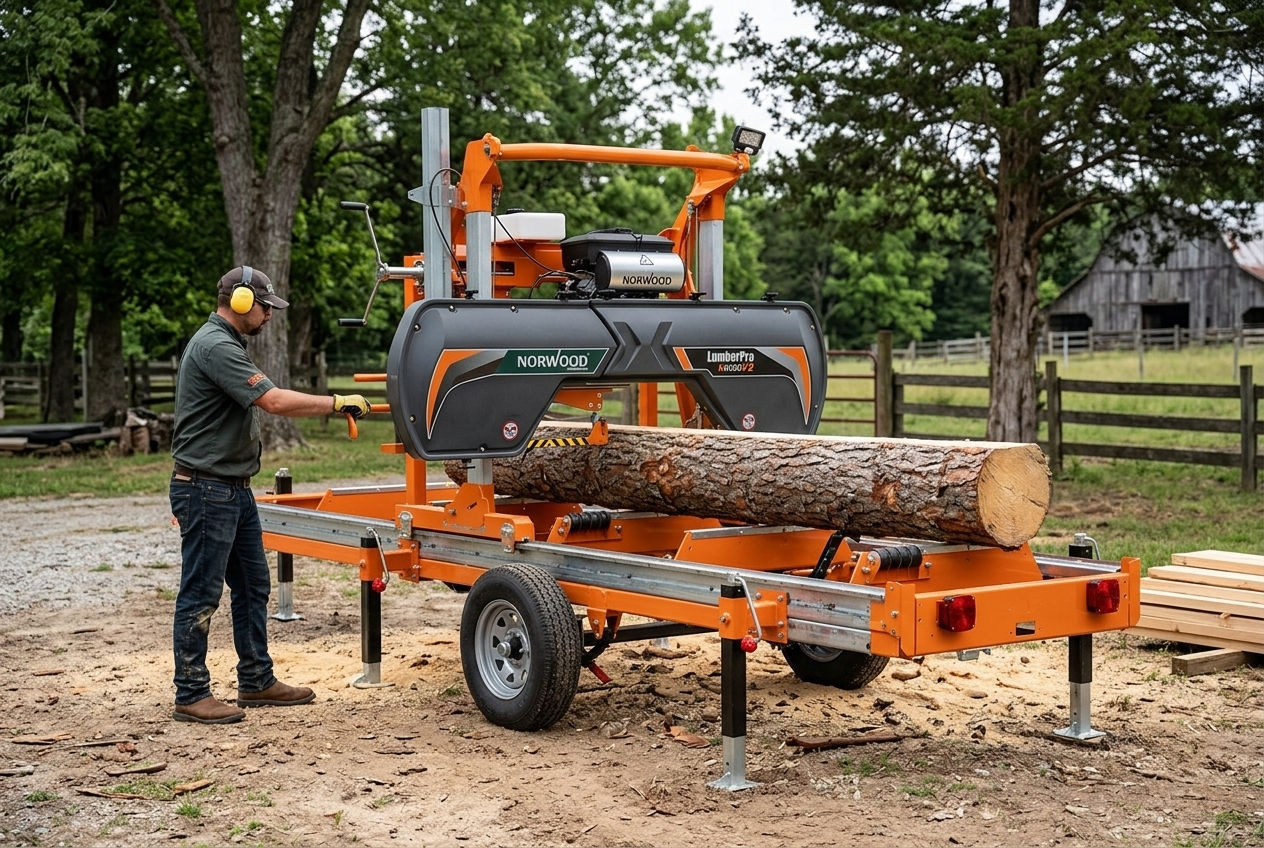
There are really three families of portable mill. Most buyers land on a bandsaw mill, but the other two exist because they genuinely do some things better. Here’s how they stack up.
| Type | How it cuts | Max log (typical) | Kerf (waste) | Rough price | Best for |
|---|---|---|---|---|---|
| Chainsaw (Alaskan) mill | A frame rides on the chainsaw bar to rip slabs | ~18–36″ (bar-limited) | Wide (~5/16″) | $200–$1,000 | Occasional use, huge slabs, carrying the mill to remote logs |
| Bandsaw mill | Thin band blade on wheels moves through the log on a track | ~26–36″ | Thin (~1/8″) | $3,000–$55,000+ | Nearly everyone — best balance of speed, yield, and cost |
| Swing-blade mill | A circular blade swings 90° to cut vertical and horizontal in one pass | Very large / any size | Wider than band (~5/16″) | $6,000–$40,000 | Oversized logs and wide dimensional stock |
Chainsaw (Alaskan) Mills
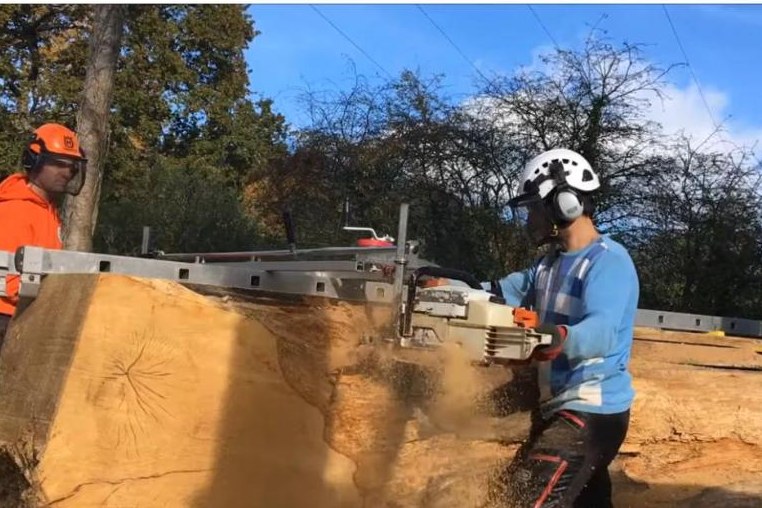
A chainsaw mill is a jig — usually an aluminum frame like the Granberg Alaskan MKIV — that clamps onto your chainsaw bar and guides it through the log to rip flat slabs. It’s the cheapest way into milling by a wide margin: the frame itself runs $200 to $400, and complete kits with longer bars start around $990. You supply the chainsaw, and it needs to be a real one — 60cc minimum, ideally 80cc-plus for hardwood, running a ripping chain filed at a shallow angle rather than a standard crosscut chain.
The honest trade-off: it’s slow, physically punishing, and it wastes a lot of wood. That 5/16″ kerf means every cut turns a quarter-inch of your log into sawdust, and on a wide slab that adds up. But for someone milling a handful of slabs a year, or for that one enormous log a bandsaw mill can’t handle, a chainsaw mill is hard to beat on price and portability. Plenty of good operators start here — we cover the setup in detail in our guide to setting up an Alaskan chainsaw mill for your first cut.
Bandsaw Mills
This is the workhorse and, for probably 90% of buyers, the right answer. A thin band blade — about 1/8″ thick — is the whole story. That thin kerf means you get more boards out of every log, the cuts are cleaner and more consistent than a chainsaw mill, and the process is far faster and less exhausting. A one-person bandsaw mill can turn a 20″ log into a stack of boards in the time it’d take to make two or three passes with an Alaskan mill.
Bandsaw mills scale across the entire price range, from $3,000 hobby units to $55,000 production machines, which is exactly why the “which one” question gets complicated. We break down the actual models and current prices in our best portable sawmill for the money guide. The kerf advantage alone is worth understanding before you buy — see the yield section below.
Swing-Blade Mills
A swing-blade mill uses a circular blade that pivots 90 degrees, making a vertical cut and a horizontal cut in a single pass down the log. Their party trick is oversized logs — a swing-blade will happily eat a 4-foot-diameter monster that would stop a bandsaw mill cold, and it can cut wide dimensional timber and beams other portable mills can’t. The downside is a wider kerf than a bandmill and a higher entry price for the capability. Unless you’re regularly milling very large logs or cutting big structural timbers, most operators don’t need one.
Manual vs. Hydraulic: The Decision That Actually Matters
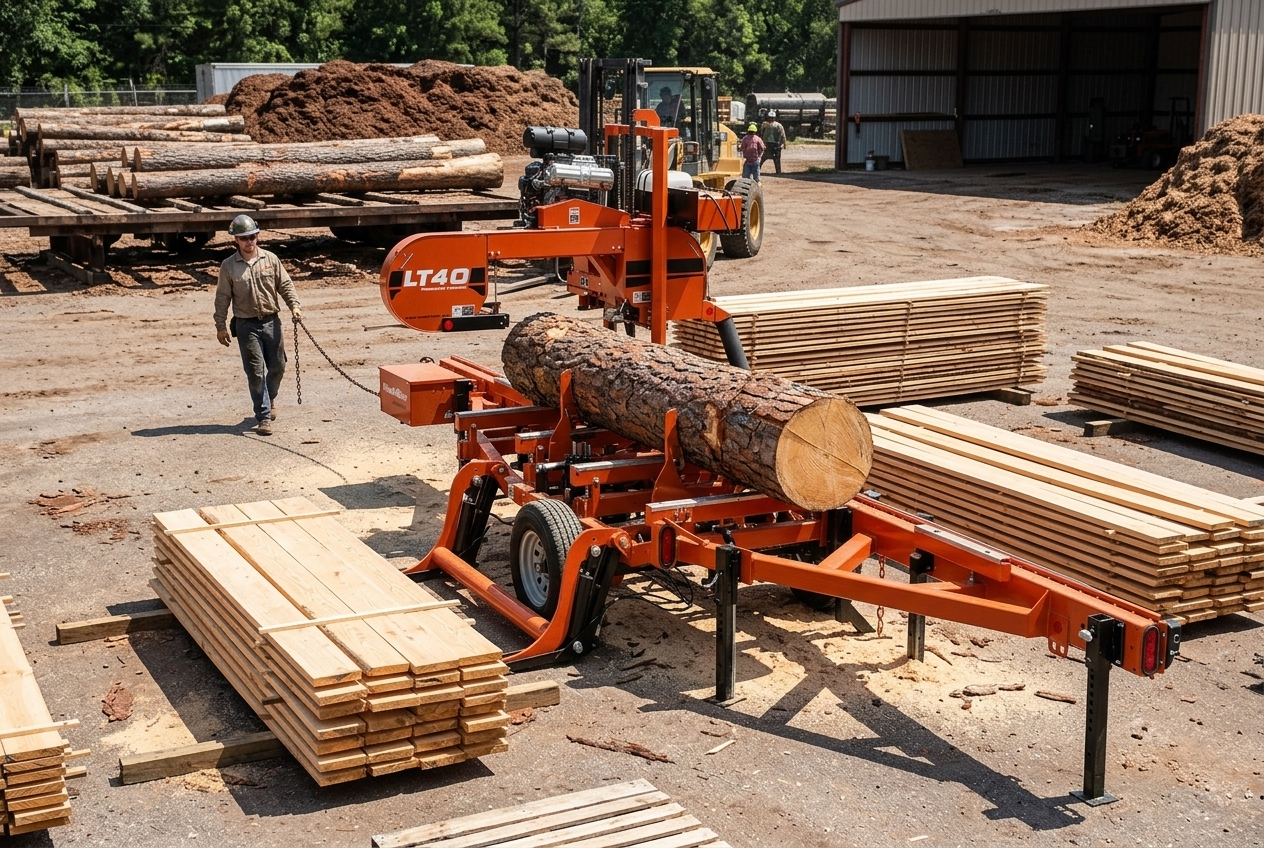
Manual mills make you load, turn, clamp, and advance the log by hand; hydraulic mills do that heavy lifting with powered arms and controls. The rule of thumb: if milling is a hobby or a side gig, buy manual; if it’s going to be your income, buy hydraulics.
This is the single biggest fork in the road, and it’s not really about cut quality — a $10,000 manual Norwood cuts the same 36″ oak log as a $30,000 hydraulic Wood-Mizer. What you’re buying with hydraulics is throughput and your own back. On a manual mill, you’re rolling logs onto the bed with a cant hook, turning the cant by hand between cuts, and setting clamps yourself. That’s fine for a Saturday. Do it for eight hours a day, five days a week, and it’s a different story.
Hydraulic functions — a powered log loader, a hydraulic turner, clamps, and toe-boards that lift one end of the log — each remove a physical, time-consuming step. On volume work they roughly double how much wood one person can cut in a day and dramatically cut fatigue. That’s why a 15-year pro milling millions of board feet will tell you flatly that full hydraulics are non-negotiable for a living. But those functions add real money: on a Norwood, a full hydraulics package can add roughly $12,000 to the base price, and Wood-Mizer’s entry hydraulic mill jumps to around $30,000-plus.
Our take from running a manual LT15: for a hobbyist or someone milling their own lumber, manual is the right call and the money is better spent on capacity and a good engine. The day you start booking paid jobs and cutting more than you comfortably can by hand is the day hydraulics start paying for themselves.
From experience (Jason): The upgrade math is bigger than it looks. Hydraulics on their own might only be a $10,000–$12,000 option, but you can’t bolt them onto an LT15 — stepping up to a factory-hydraulic Wood-Mizer means buying a bigger, more advanced mill too, so you’re really spending about $16,000–$19,000 more all in. Whether that’s worth it comes down to one question: how do you load logs today? If you don’t have a skid steer, a small tractor, or another solid way to move and roll logs, hydraulics earn their keep — they save your back, let you work alone, and get more done in a day. But if you already own a skid steer or tractor, you’ve already solved most of what those hydraulics do.
So run the payback before you spend it. On roughly $17,000–$18,000 of extra cost: if you’re clearing an extra dollar a board foot, you’d need to cut and sell about 17,000–18,000 additional board feet just to break even. At 50 cents a board foot, it’s more like 34,000–36,000 board feet. Unless the hydraulic mill is genuinely going to let you sell a lot more lumber or cut out hired labor, I’d keep the money and run the LT15 with the loader equipment I already have.
How Much Does a Portable Sawmill Cost?
Portable sawmills break into four rough price tiers: chainsaw mills at $200–$1,000, entry bandsaw mills at about $3,000–$8,000, mid-range manual mills at roughly $9,000–$18,000, and professional hydraulic mills from about $30,000 to $55,000-plus. Here’s the tier map with real 2026 examples.
| Tier | Price range | Example models (base, mid-2026) | Who it’s for |
|---|---|---|---|
| Chainsaw mill | $200–$1,000 | Granberg Alaskan MKIV (~$323 jig) | Occasional slabs, lowest budget |
| Entry bandsaw | $3,000–$8,000 | Woodland Mills HM126 (~$3,100), Frontier OS27 (~$4,100), Woodland HM130MAX (~$7,800) | Serious hobbyists |
| Mid-range manual | $9,000–$18,000 | Wood-Mizer LT15 family (~$7,900 base up to ~$12,000), Norwood LumberPro HD36V2 (from ~$10,800) | Heavy hobby / part-time income |
| Professional / hydraulic | $30,000–$55,000+ | Wood-Mizer LT35 Hydraulic (~$30,000), LT40 Hydraulic (~$36,000+) | Full-time production |
Two things the price tags don’t show. First, the mill is the start of the spending, not the end: replacement blades run about $20 each and want sharpening after roughly two hours of cutting (you can resharpen a blade several times before it’s done), plus fuel, a moisture meter, and eventually a trailer if you go mobile. Second, base prices are exactly that — base. Add hydraulics, a bigger engine, or wider cutting capacity and the number climbs fast. We put real dollar figures on all of it, including the running costs, in our complete portable sawmill cost breakdown.
How to Choose: Match the Mill to Your Board-Foot Goal
Forget brand loyalty for a minute. The cleanest way to choose is to be honest about how much you’ll cut, then work backward to the tier. Here’s the framework we’d give a friend.
| If you’ll cut… | Buy this tier | Manual or hydraulic | Log capacity to look for |
|---|---|---|---|
| A few slabs a year | Chainsaw mill | Manual (it’s the only option) | Bar length + your saw |
| Your own lumber, occasional projects | Entry bandsaw | Manual | 26″ diameter is plenty |
| Lots of your own wood + a few paid jobs | Mid-range manual | Manual, hydraulic-capable | 30–36″ diameter |
| A part- or full-time income | Professional | Hydraulic | 32″+ and fast blade feed |
Beyond the tier, three specs actually matter when you’re comparing two mills:
- Log diameter capacity. How big a log fits between the bed rails and under the sawhead. Entry mills handle around 26″, mid-range mills 30–36″. Measure the biggest logs you realistically expect and add a margin.
- Engine and power. More horsepower means faster, cleaner cuts in hardwood. Gas dominates the field, but electric and even battery mills now exist for low-noise or indoor use — Wood-Mizer launched the first battery-powered portable mill in late 2023, and it’s worth a look if fumes and noise are a problem where you cut.
- Parts and blade support. An orphan brand with no blade supply is a headache. Established names (Wood-Mizer, Norwood, Woodland Mills, Frontier) all sell blades and parts direct, which matters more than buyers expect.
Ground-Mount vs. Trailer-Mounted: Which Setup Do You Need?
Buy a trailer-mounted mill only if you’ll take it to logs you can’t bring home; for most people, a ground-mounted mill in a fixed spot is cheaper and just as useful. A ground-mounted mill sits on blocks, rails, or a simple pad in your yard, and you haul logs to it with a tractor, truck, or trailer. It’s less expensive, and honestly it’s how most hobby and part-time operators run.
A trailer-mounted mill is built onto a road-legal trailer so you can tow it to a customer’s property or a remote woodlot and mill on-site. That mobility is genuinely valuable if you’re custom-sawing for other people — a lot of clients want their own logs milled where they lie, since a pile of logs is far harder to move than a compact mill. But you’re paying for the trailer, and you’ll spend time setting up and leveling at every stop. Our advice: start ground-mounted, and add mobility only when paying jobs are pulling you off your own property.
Gas, Electric, or Battery? The Power Question
Gas engines still power the overwhelming majority of portable mills, and for good reason — they’re powerful, refuel in seconds, and go anywhere. Diesel shows up on bigger production mills for torque and fuel economy. But the field is changing: Wood-Mizer launched the industry’s first battery-powered portable mill in late 2023, and electric mills are a real option now.
Electric and battery mills make sense in specific situations: milling inside a shop or barn where exhaust is a problem, working somewhere noise matters, or simply wanting to skip engine maintenance and fuel-price swings. In testing, the battery LT15 ran up to around eight hours on a set of lithium batteries. The trade-off is runtime and recharge time versus just topping off a gas tank, and electric ties you to a power source or charged packs. For field work and true portability, gas is still the default; for a fixed indoor setup, electric is worth a hard look.
USA-Built vs. Imported: What the Price Difference Buys
You’ll see very cheap imported bandmills online — sometimes a third of the price of a Woodland or Wood-Mizer — and it’s a fair question whether the premium for an established brand is worth it. Here’s our honest take after being around both.
A cheap import can absolutely cut wood on day one. Where the gap shows up is over time: blade and parts availability, build quality on the wear points, and resale value. When a bearing or a guide goes on an orphan-brand mill and no one stocks the part, a “bargain” becomes a boat anchor. Established brands — Wood-Mizer, Frontier, and Granberg are US-built; Woodland Mills and Norwood are well-supported North American brands — sell blades and parts direct and hold their value if you ever sell. That said, we won’t pretend a well-kept import can’t serve a light-duty owner. The rule we’d give: for occasional, low-stakes milling, an import can make sense; for anything you’ll lean on or eventually resell, buy a supported brand. The support network is the real product.
What It’s Actually Like to Run One
Buying guides rarely tell you what the work feels like, so here’s the reality. Milling is part sawing, part log wrangling. You’ll spend real time moving logs, and on a manual mill, turning and clamping them between cuts. The sawing itself, once the log is set, is oddly meditative — you set a thickness, push the head through, drop it, and repeat.
Blades are consumables, full stop. Expect to swap and resharpen them constantly; a blade wants a touch-up after roughly two hours of cutting, and you’ll go through several on a busy day. Your first few cuts probably won’t be perfect — wavy cuts are the classic beginner frustration, and they usually come down to blade tension, feed rate, or a dull band. We wrote a whole guide on fixing wavy cuts on a bandsaw mill because it’s the number-one thing new operators hit. And if you’re starting on a chainsaw mill, our Alaskan mill setup walkthrough and our best chainsaws for milling roundup will get your first cut clean. The learning curve is real but short — most people are cutting usable lumber within their first day or two.
The Kerf Math Nobody Explains (But You Should Know)
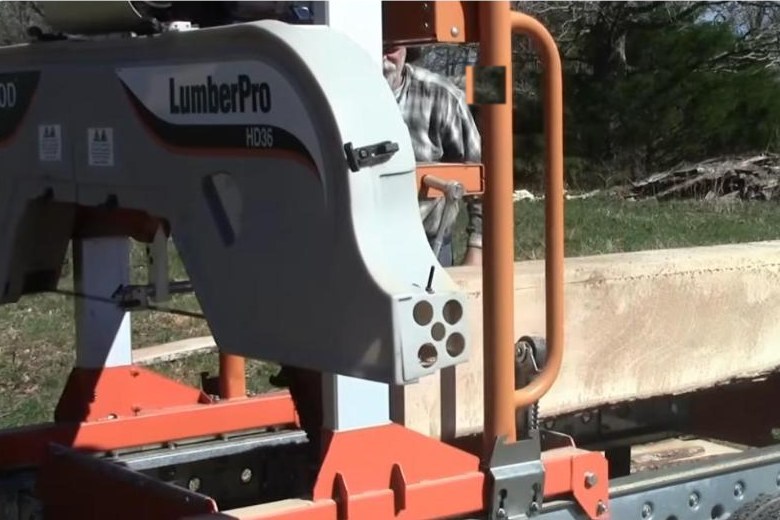
Here’s the section most buying guides skip, and it’s the one that actually separates the machines. A bandsaw mill’s blade cuts a kerf of about 1/8″, while a chainsaw or circular mill cuts about 5/16″ — more than double the wood turned to sawdust on every single cut.
That difference compounds. Industry yield data pegs each 1/32″ of kerf reduction at roughly 2.1% less wood wasted. Going from a chainsaw mill’s 5/16″ kerf to a bandmill’s 1/8″ — a gap of 6/32″ — recovers on the order of $60 more lumber per thousand board feet at typical lumber values. Cut 100,000 board feet a year and that’s around $6,000 in wood you’re keeping instead of sweeping up. And because the kerf is thinner, more of your boards come out full-width and full-length instead of falling a hair short.
You don’t need to memorize the numbers. The point is simple: on a chainsaw mill you pay a low price up front and give a little wood back on every cut; on a bandsaw mill you pay more up front and recover it in yield over time. For anyone cutting real volume, the bandmill’s thin kerf is a big reason it dominates.
Can You Actually Make Money With a Portable Sawmill?
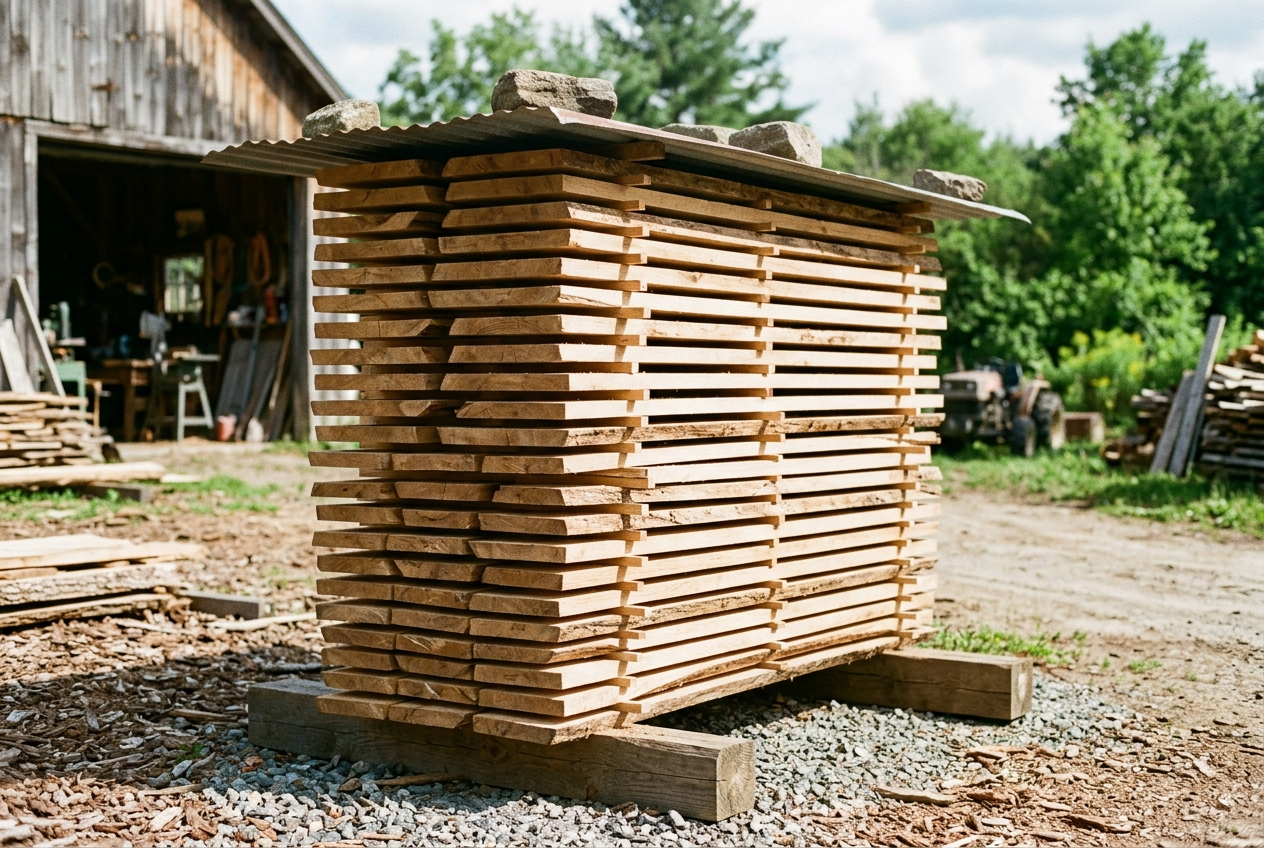
Yes — many operators charge $0.25–$0.35 per board foot or roughly $45–$75 per hour for custom sawing, and a mill can pay for itself, but it’s work, not passive income. The economics are real. Custom-sawing other people’s logs, milling urban and storm wood into slabs for furniture makers, or selling your own dried lumber all turn a mill into a revenue tool rather than a toy.
The catch is that the money follows the effort and the equipment. Hourly billing tends to produce better cuts because you’re not rushing to maximize board feet, while per-board-foot pricing rewards speed — which is exactly where hydraulics earn their keep. Blades, fuel, maintenance, and your own time all come out of that rate, so the honest picture is a solid side income for a hobby-tier operator and a genuine living for someone who’s tooled up and treats it like a business. We dig into the numbers, plus what mill makes sense at each budget, in the best portable sawmill for the money guide.
Frequently Asked Questions
What is a portable sawmill and how does it work?
A portable sawmill is a transportable machine that cuts logs into lumber on-site. On the most common type, a bandsaw mill, a thin band blade on two wheels is carried through the log along a level track; you set each board’s thickness by raising or lowering the sawhead, push it through, and repeat. It brings the saw to the log instead of hauling logs to a commercial mill.
How much does a portable sawmill cost?
Chainsaw mills run about $200 to $1,000, entry-level bandsaw mills about $3,000 to $8,000, mid-range manual mills roughly $9,000 to $18,000, and professional hydraulic mills from about $30,000 to $55,000-plus. Budget for blades, fuel, and a moisture meter on top of the base price.
Is a bandsaw mill or a chainsaw mill better?
For most people, a bandsaw mill — it’s faster, the cuts are cleaner, and its thin 1/8″ kerf wastes far less wood than a chainsaw mill’s 5/16″ kerf. A chainsaw mill wins only on price and portability, or for occasional slabbing of logs too big for a bandmill.
Do I need hydraulics on a portable sawmill?
Only if you’re cutting volume for income. Hydraulics power the log loading, turning, and clamping, roughly doubling how much one person can cut in a day and saving your back — but they add thousands to the price. For hobby and occasional use, a manual mill cuts identical lumber for far less.
What size logs can a portable sawmill cut?
Entry bandsaw mills typically handle logs up to about 26″ in diameter, and mid-range to professional mills 30–36″. Swing-blade mills can cut much larger, effectively any size, while a chainsaw mill is limited by your bar length. Match capacity to the biggest logs you realistically expect to mill.
The Bottom Line
A portable sawmill is one of the few tools that can genuinely pay for itself, but only if you buy for the work you’ll actually do. Be honest about your board-foot goal, start with the tier that fits it, choose manual unless income demands hydraulics, and don’t underestimate the thin-kerf yield advantage of a bandmill. Get those four things right and you’ll skip most of the mistakes we made learning the hard way.
Ready to pick a machine? Start with our tier-by-tier best portable sawmill for the money breakdown, or if you’re budgeting first, see the full portable sawmill cost guide. And when your saw is doing the milling, our pick of the best chainsaws for milling lumber will point you at the right powerhead.
Written by Jason Lewis, a working sawyer who runs a Wood-Mizer LT15 milling upper-Midwest hardwoods.