
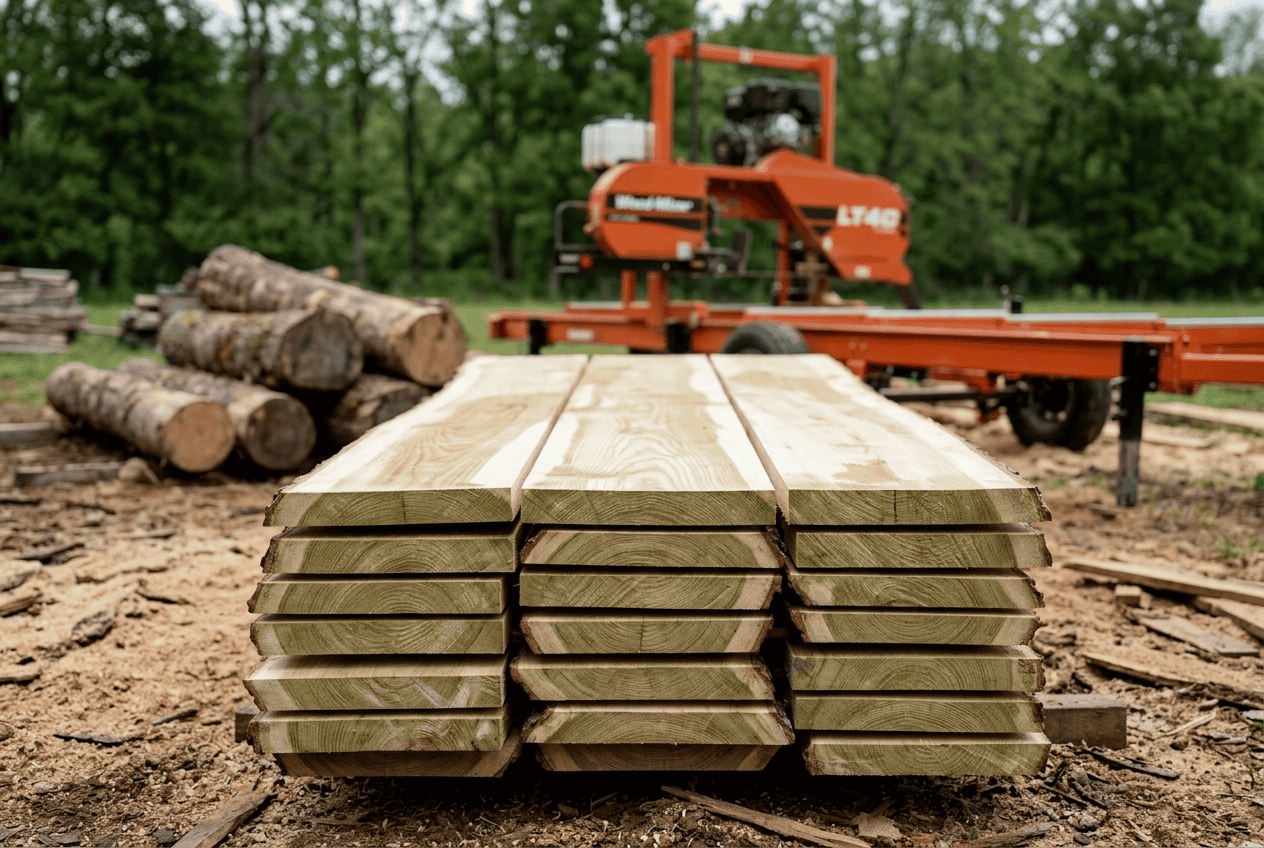
Log scale + board feet estimator
Cut Side Board Foot Calculator
Optional money check
What this size job needs
I run a Wood-Mizer LT15 in the upper Midwest, and the most common question I get — from customers, from guys buying their first mill, from a landowner staring at a downed oak — is some version of “how much wood is in this, and what’s it worth?” That’s really three questions hiding inside one, and most pages online only answer a slice. This one answers all of it: how to figure board feet in a finished board, how to estimate the yield inside a log, and how to turn those numbers into dollars — whether you’re buying lumber, selling it, or milling it yourself.
Punch your numbers into the calculator above first. Then use the rest of this guide to understand what the answer means and where the money is.
Last updated July 2026 · Jason Lewis runs a Wood-Mizer LT15 in the upper Midwest and has spent years milling hardwoods, scaling logs, and pricing lumber for custom-saw customers.
What Is a Board Foot?
A board foot (BF or bd. ft.) is a unit of volume equal to 144 cubic inches — a piece 1 inch thick, 12 inches wide, and 12 inches long. It’s one square foot of wood, one inch thick. Lumber is sold this way because it measures the actual amount of wood, not just length or face area.
- 1 board foot = 144 cubic inches = 1/12 of a cubic foot
- MBF = 1,000 board feet — the standard wholesale/mill unit
- Board foot vs. linear foot: a linear foot measures length only; a board foot measures volume
- Board foot vs. square foot: a square foot is flat area; a board foot includes thickness
How to Calculate Board Feet in a Board
Two versions of the formula — same math, the only difference is whether length is in inches or feet.
Use ÷144 when everything is in inches. Use ÷12 when thickness and width are in inches but length is in feet. Both give the identical answer.
Worked examples
- A 2×4×8 (softwood): 2 × 4 × 8 ÷ 12 = 5.33 BF
- A 5/4 × 10″ × 8 ft plank: 1.25 × 10 × 8 ÷ 12 = 8.33 BF (five = 41.67 BF; at $4.15/BF = $172.92)
- An 8/4 × 6″ × 8 ft board: 2 × 6 × 8 ÷ 12 = 8.0 BF
The 4/4, 5/4, 8/4 “quarter” system
Rough hardwood is quoted in quarters of an inch. The top number is the thickness in quarter-inches, so 4/4 is four quarters — one inch:
| Call | Rough thickness | Typical surfaced (S2S) |
|---|---|---|
| 4/4 | 1″ | ~13/16″ |
| 5/4 | 1¼″ | ~1-1/16″ |
| 6/4 | 1½″ | ~1-5/16″ |
| 8/4 | 2″ | ~1-3/4″ |
Board foot reference chart
| Size | 4/4 (1″) stock | 8/4 (2″) stock |
|---|---|---|
| 4″ × 4 ft | 1.33 BF | 2.67 BF |
| 6″ × 8 ft | 4.00 BF | 8.00 BF |
| 12″ × 12 ft | 12.00 BF | 24.00 BF |
How Many Board Feet Are in a Log?
You can’t just measure a log’s volume and call it lumber, because milling loses wood to the saw kerf (sawdust), the rounded slabs and edgings you trim off, and taper. So the industry uses log rules — formulas that estimate how much usable lumber a log will yield.
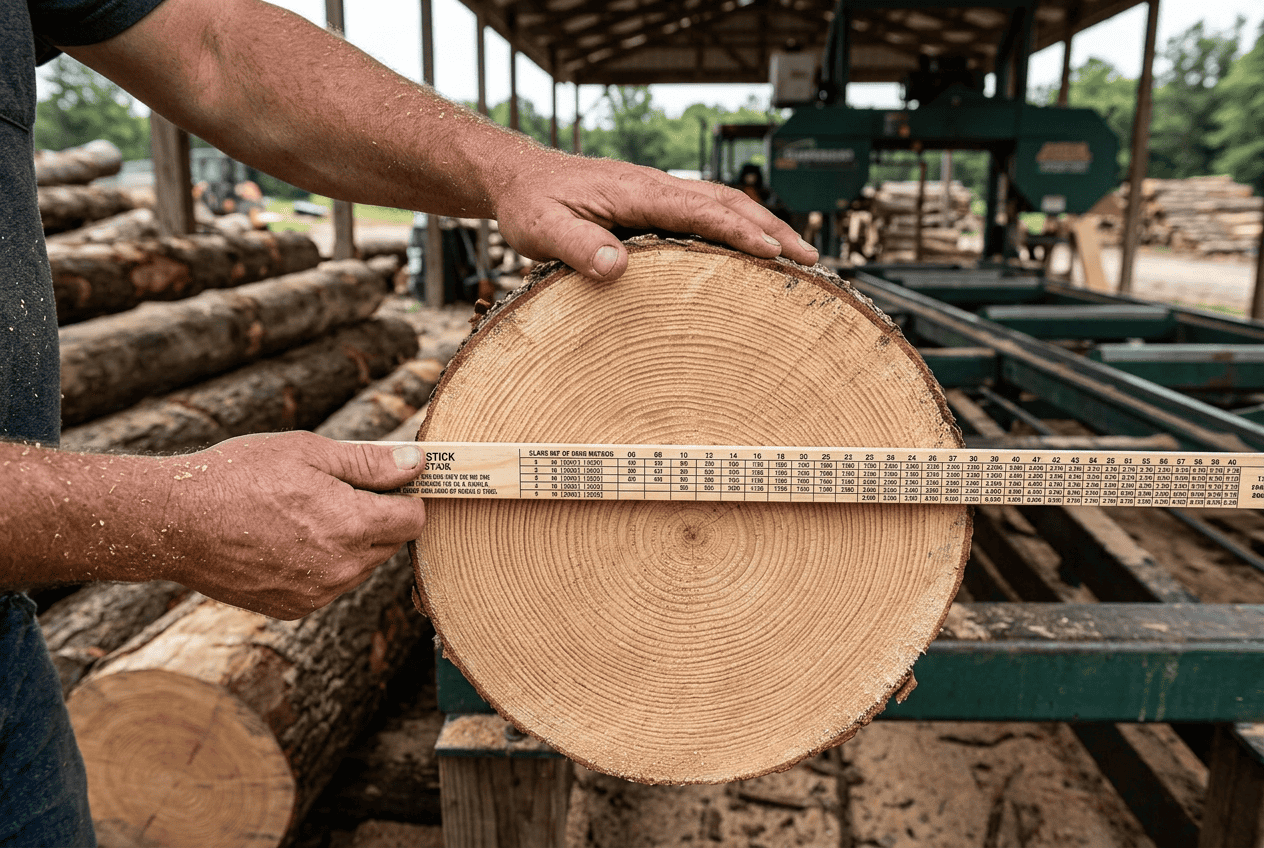
Every log rule needs two measurements: the diameter at the small end, inside the bark (D, inches), and the length (L, feet). Measure the small end and knock off anything obviously rotten.
The three log rules
Doyle (1825) — the most common rule for hardwood log trading in the eastern and southern U.S. It subtracts a fixed 4″ ring for slab waste:
Because that 4″ deduction is fixed, it eats a huge fraction of a small log but barely touches a big one — so Doyle badly under-scales small logs. That’s why buyers love it and sellers grumble.
Scribner (1846) — a “diagram rule” drawn by packing boards inside a circle. More realistic than Doyle on small logs, but it ignores taper, so mills often overrun it.
International ¼″ (1906) — the accurate one. Calculated in 4-foot segments, it accounts for both the saw kerf and realistic taper. Forestry extension offices treat it as the benchmark.
Same log, three different answers
Here’s why you always ask which rule a price is quoted in. A 16″-diameter, 16-foot log:
| Log rule | Board feet | Notes |
|---|---|---|
| Doyle | 144 | (16−4)² × 1 — the buyer’s favorite |
| Scribner | 159 | middle of the road |
| International ¼″ | 180 | closest to true yield |
That’s a 36 board-foot spread — 25% — on the exact same log. On a 20″×16 ft log the numbers tighten (Doyle 256, Scribner 280, International 290), and on very large logs Doyle eventually catches up. But on the small-to-medium logs most of us handle, Doyle pays you the least.
Which log rule should you use?
- Buying hardwood logs in the East/South? You’ll be quoted in Doyle whether you like it or not — just know it under-scales small logs, so a pile of little logs is a worse deal than it looks.
- Want the truest picture of what a log will actually yield? Use International ¼″. It’s the one I trust when deciding whether a log is worth loading on the mill.
- Selling logs? Push for Scribner or International if you can. On small logs, being paid in Doyle can cost you 20–30% of your wood.
 (for buying/selling hardwood in the East and South) and the International ¼″ Scale Stick (for the truest yield estimate). I keep one in the truck next to the tape measure. As an Amazon Associate, The Cut Side may earn from qualifying purchases — at no extra cost to you.
Doyle log scale — quick reference (board feet)
| Small-end dia. | 8 ft | 10 ft | 12 ft | 14 ft | 16 ft |
|---|---|---|---|---|---|
| 10″ | 18 | 23 | 27 | 32 | 36 |
| 16″ | 72 | 90 | 108 | 126 | 144 |
| 20″ | 128 | 160 | 192 | 224 | 256 |
| 24″ | 200 | 250 | 300 | 350 | 400 |
As a rule of thumb, a single mature saw-timber tree yields roughly 250–500 board feet.
Board Foot Prices by Species
The part everyone came for. Prices below are 2025–2026 U.S. ranges for mill-direct lumber; a retail dealer runs higher, and surfaced (S4S) stock adds roughly $3–$5/BF on top. Expect ±20–30% swings by region — price against your local market, not a national average.
| Species | Green / rough | Air-dried | Kiln-dried |
|---|---|---|---|
| Black walnut | $6.00–$6.50 | $7.50–$8.50 | $8.50–$12 |
| White oak | $4.00–$5.50 | $5.00–$7.50 | $7.00–$9.50 |
| Cherry | $4.00–$4.50 | $5.00 | $6.25–$8 |
| Hard maple | $3.00–$4.00 | $4.00–$5.00 | $5.00–$7.00 |
| Red oak | $2.50–$3.00 | $3.50–$4.50 | $4.50–$5.50 |
| Ash | $2.50–$3.50 | $3.00–$4.00 | $4.00–$5.00 |
| Poplar | $1.50–$2.00 | $2.50 | $3.00–$4.00 |
| Eastern white pine | $1.00–$2.00 | $2.00–$2.50 | $3.00–$4.00 |
| Aromatic cedar | $3.00–$4.00 | $4.00 | $5.00–$6.00 |
What drives the spread: species and rarity (walnut and white oak run 2–4× red oak or pine), how dry it is (green to kiln-dried is often a 50–80% jump), thickness (8/4 adds $1–$3/BF over 4/4), grade (clear FAS vs. knotty common), and figure (curly, crotch, quartersawn, or spalted commands a premium).
Live-edge slabs are their own market
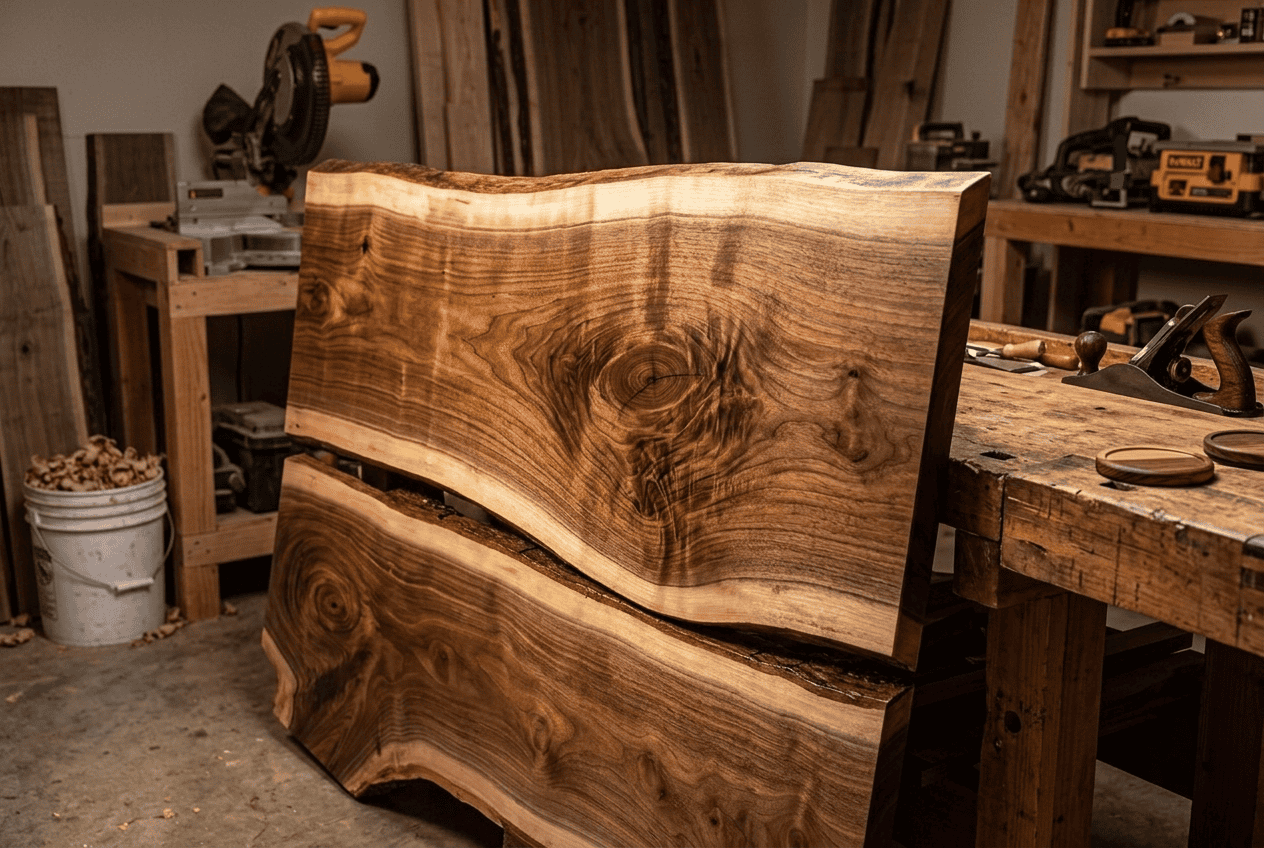
Slabs get priced per board foot too, but the rate climbs with width — because wide slabs only come from big, old, increasingly rare logs. Kiln-dried walnut slabs commonly run from $13/BF at 20″ wide up to $28/BF at 45″+, with individual slabs listing anywhere from $550 to $1,500 apiece — before flattening and finishing.
How Much Money Can You Make Milling Lumber?
A portable sawmill can absolutely make money, but almost never by selling plain green lumber. The money lives in three places — free logs, drying, and value-added products. Here’s the math instead of the hype.
Custom sawing rates (the fastest cash)
Sawing other people’s logs on their property is the lowest-risk way in: no log cost, no inventory, paid the same day.
| Charge | Typical range |
|---|---|
| Per board foot | $0.25–$0.50/BF (up to ~$0.75 for hardwood/difficult logs) |
| Hourly | $65–$105/hr |
| Setup / transport | ~$50 (plus $1.00–$1.25/mile) |
| Blade damage (hitting metal) | $20–$25 per ruined blade |
At a realistic ~200 BF/hour, $0.50/BF works out to about $100/hour — so the two models roughly meet there. Charge per board foot when you control the logs and they’re clean and big; charge hourly when they’re small, crooked, or full of hidden nails. Always keep the metal-strike fee on your rate sheet — urban logs are landmines.
A day of custom sawing: 8 productive hours × 200 BF/hr = 1,600 BF. At $0.35/BF that’s $560; at $0.50/BF it’s $800. Subtract ~$10 fuel and a couple of blades (~$50), add setup and mileage, and a clean day nets roughly $500–$750.
The real money: value-add stacking
Here’s where a free log becomes a business. Say a tree service drops off a 24″ walnut butt log they’d otherwise pay to dump. Milled into 8/4 live-edge slabs, it yields around 120 BF of 28–34″-wide material:
| Stage | Value of that one free log |
|---|---|
| Sold as green slabs (~$6.50/BF) | ~$780 |
| Air-dried (~$8.50/BF) | ~$1,020 |
| Kiln-dried live-edge (~$18/BF) | ~$2,160 (minus ~$120 drying) |
Same log. $780 green versus $2,000+ finished. That gap — between a raw log and dried, sellable lumber — is the business. It’s why a kiln is the highest-ROI upgrade after the mill itself, and why the people actually making a living are turning slabs into charcuterie boards, tables, and coops rather than selling board feet by the stack.
An honest reality check
At hobby scale, a mill is mostly a tool that pays for its own lumber — you’ll cut project wood for a fraction of retail, and that’s a real win. Turning it into income takes volume (full-timers run 3,500–4,000 BF/week), drying capacity, and ideally a finished product you can mark up. The “$1,000,000 a year” headlines exist, but they’re value-add operations, not sawing operations. Know which game you’re playing before you buy the mill.
If you’re weighing a purchase, I broke the numbers down in How Much Does a Portable Sawmill Cost? and matched mills to budgets in Best Portable Sawmill for the Money. New to all of this? Start with The Complete Guide to Portable Sawmills.
Frequently Asked Questions
How do you calculate board feet?
Multiply thickness (in) × width (in) × length (in) and divide by 144. If your length is in feet, use thickness × width × length ÷ 12 instead. Both formulas give the same number.
How many board feet are in a 2×4×8?
5.33 board feet. You calculate it on the nominal 2×4 size (2 × 4 × 8 ÷ 12), not the actual 1½″ × 3½″ dimensions.
What do 4/4, 5/4, and 8/4 mean?
They’re rough hardwood thicknesses in quarter-inches: 4/4 = 1″, 5/4 = 1¼″, 8/4 = 2″. You’re billed on this rough thickness, not the thinner planed dimension.
Do I use rough or finished thickness?
Rough. A 4/4 board planed to 13/16″ is still charged as a full board foot per square foot of face — you pay for the wood removed in surfacing.
How do you figure board feet in a log?
Use a log rule with the small-end, inside-bark diameter (D, inches) and length (L, feet). Doyle = (D−4)² × L/16; International ¼″ is more accurate but more complex, so most people read it off a scale table.
Which log rule is most accurate?
The International ¼-inch rule. It accounts for both saw kerf and log taper, which is why forestry extension services use it as the benchmark. Doyle under-scales small logs; Scribner sits in between.
Why does Doyle give a smaller number than International?
Doyle subtracts a fixed 4″ for slab waste and ignores taper, so it removes a big proportion of a small log. A 16″×16 ft log scales 144 BF in Doyle but 180 BF in International — a 25% difference on the same log.
How much does a portable sawmill owner charge?
Typically $0.25–$0.50 per board foot, or $65–$105 per hour, plus a setup/travel fee and a blade-damage fee if a log hides metal. Hardwood and difficult logs run toward the top of the range.
How much more is kiln-dried lumber worth than green?
Roughly 50–80% more end-to-end. Green red oak around $3/BF becomes about $5.50/BF kiln-dried, while custom kiln drying only costs about $0.59–$1.21/BF — so the uplift far exceeds the cost.
Is a portable sawmill actually profitable?
It can be, but rarely from selling plain green lumber. The profit comes from free or cheap logs, drying to capture the green-to-kiln-dried spread, and value-added products. At hobby scale it’s closer to a break-even tool that supplies your own cheap lumber.
Prices and rates are 2025–2026 U.S. ranges and vary by region, grade, and market; treat them as starting points and confirm against your local numbers. This article is informational, not financial advice.
Written by Jason Lewis, a working sawyer who mills upper-Midwest hardwoods on a Wood-Mizer LT15.