
Quick Answer: Nine out of ten bandsaw mill problems trace to three root causes — a dull or wrongly chosen blade, incorrect blade tension, or a setup issue like unlevel track or worn guides. Before chasing anything exotic, install a fresh blade, verify tension against your manual’s spec, and check the track with a level. That sequence alone resolves most cutting complaints on any brand of mill.
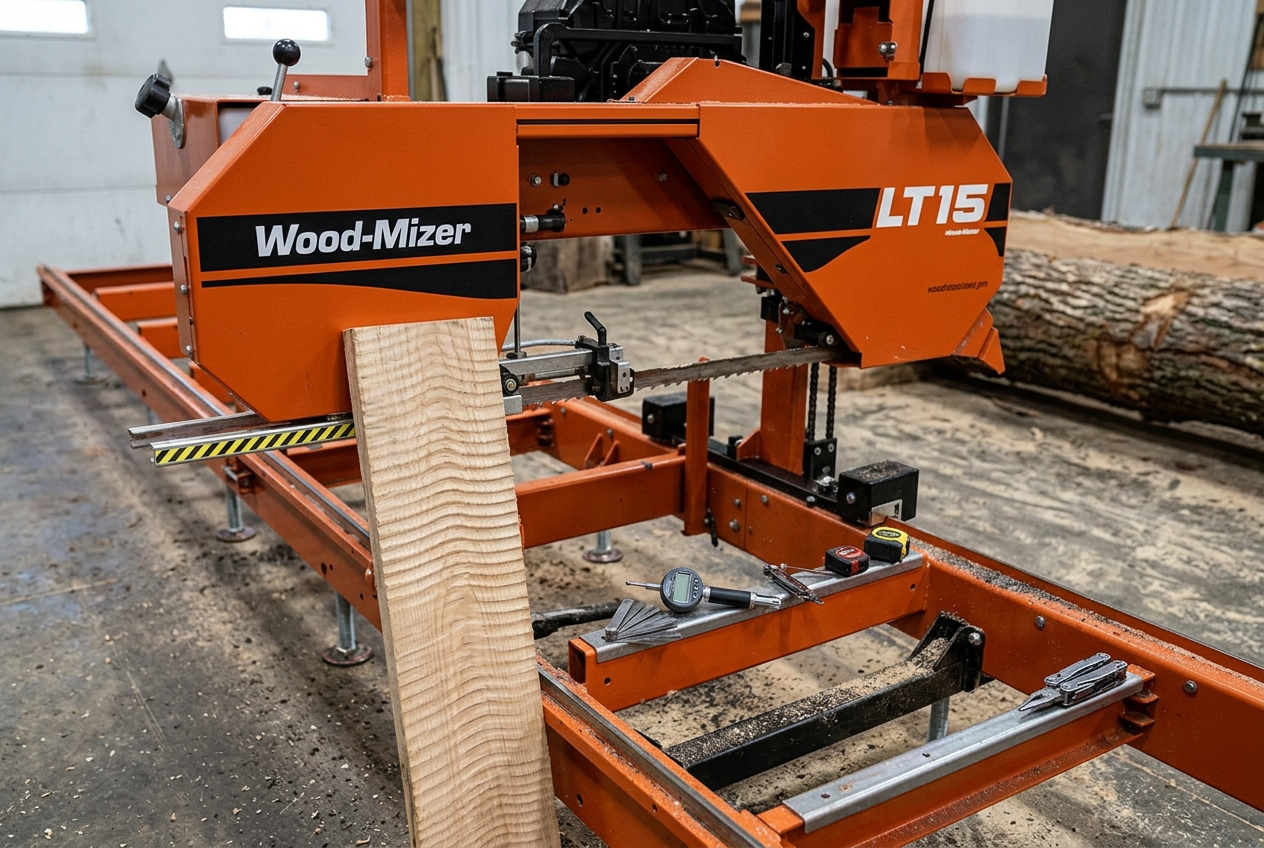
Every sawyer eventually has the day where the mill fights back: cuts go wavy, boards come off thick-and-thin, or the blade lets go mid-log. After a decade of troubleshooting our own Wood-Mizer LT15 — and helping neighbors sort out their Woodland Mills and Norwood machines — I can tell you the fixes are rarely complicated, but the diagnosis order matters. Here are the ten most common bandsaw mill problems, what actually causes each one, and the fix that works, starting with the master reference table.
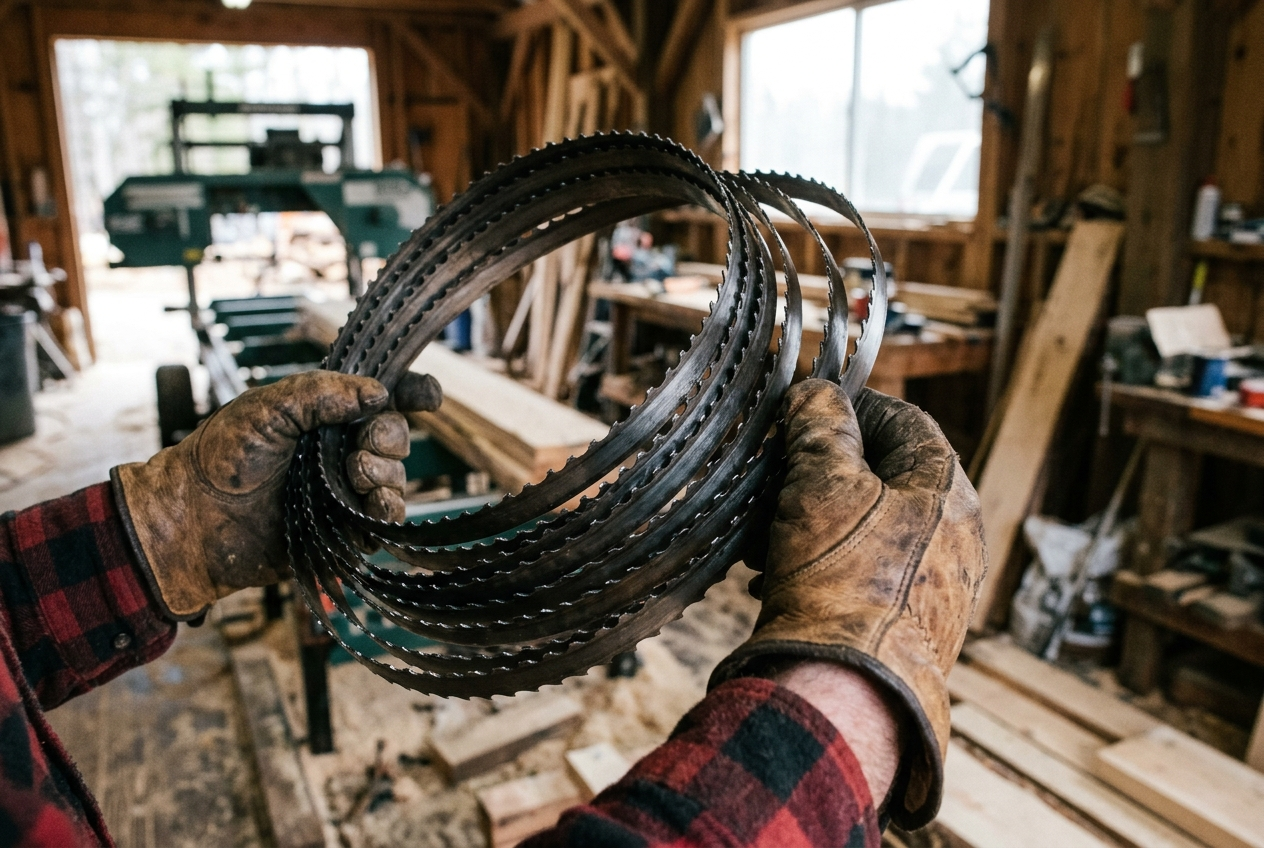
Last Updated: August 2026 | Jason Lewis has spent a decade diagnosing these exact problems on his own Wood-Mizer LT15 and on neighbors’ Norwood and Woodland Mills machines.
The Troubleshooting Table: Problem → Cause → Fix
| # | Problem | Most Likely Cause | Fix |
|---|---|---|---|
| 1 | Wavy cuts | Dull blade, low tension | Fresh blade, re-tension, slow the feed |
| 2 | Blade dives (cuts down) | Excessive hook angle, dull one side, feed too fast | Lower-hook blade, check set balance, ease feed |
| 3 | Blade climbs (cuts up) | Tooth set worn on one side, guide misalignment | Re-set or replace blade, realign guides |
| 4 | Thick-and-thin boards | Log shifting in clamps, sawhead play | Re-clamp low and tight, check head lock and rails |
| 5 | Fuzzy/rough surface | Dull teeth, lost set, pitch buildup | Sharpen and re-set, increase blade lube |
| 6 | Blade breaks early | Over-tension, worn bandwheel belts, storage kinks | Verify tension spec, inspect belts, store coiled properly |
| 7 | Excessive vibration | Sawdust packed in bandwheels, loose hardware, engine mounts | Clean wheels, torque check, inspect mounts |
| 8 | Engine bogs in the cut | Feed too fast, dull blade, fouled air filter | Ease feed, fresh blade, service the engine |
| 9 | Blade won’t track / comes off | Bandwheel alignment, worn belts, wrong tension | Adjust tracking per manual, replace belts |
| 10 | Blade dulls in one log | Dirt, embedded metal, abrasive species | Clean/debark logs, metal-detect yard trees |
1. Wavy Cuts
The classic. The blade is almost always telling you it’s dull or loose — wavy lumber through knots especially means the edge can’t hold a line under load. Swap in a fresh blade before touching anything else; if waves persist, verify tension and inspect guide rollers for wear and alignment. This one’s common enough that we gave it a full deep-dive: how to fix wavy cuts on a bandsaw mill.
From experience: my weirdest wander chase started in hickory — a 7/8-pitch blade going dull and wandering, so I swapped in a sharp 3/4-pitch blade but kept pushing the same feed rate. When the new blade wandered too, I tore into guides, tracking, and alignment before it dawned on me: I’d changed the tooth pitch but not how I was feeding it. Slowed down, and it cut straight.
2. Blade Dives
A diving blade drops out of plane and chases the bottom of the cut, usually in dense wood or knots. Too much hook angle for the species is the leading cause — a 13° softwood blade in dry oak wants to self-feed harder than the wood allows. Move to a 4°–7° blade for hard stuff, and check that both sides of the tooth set are even; a blade sharpened unevenly steers like a car with one flat tire.
3. Blade Climbs
The mirror image: the blade rises in the cut and the board fattens toward the far end. Same family of causes as diving — uneven set, misaligned guides, insufficient tension — just expressed in the other direction. Re-set or replace the blade first, then verify the guide rollers hold the band in one plane from entry to exit.
4. Thick-and-Thin Boards
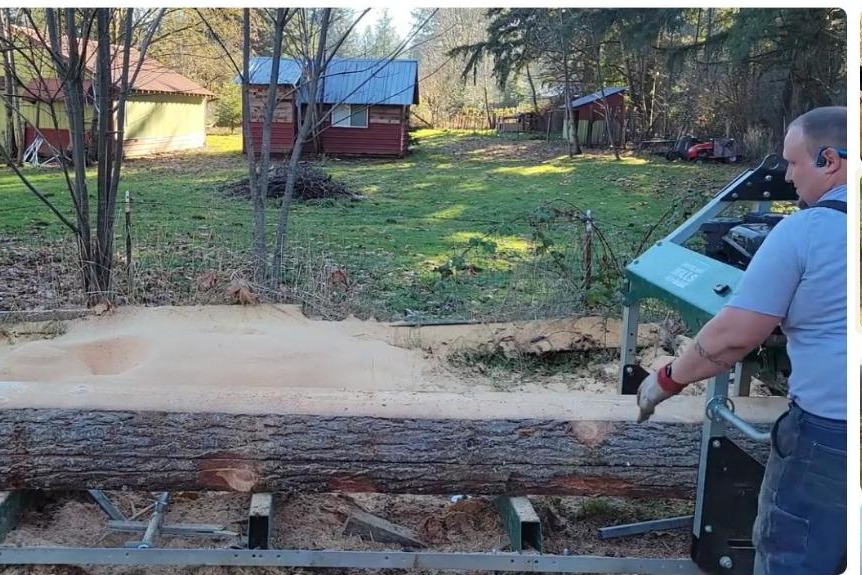
If board thickness varies along the length, something moved: either the log in its clamps or the sawhead on its rails. Re-clamp lower and tighter — the log must not rock — and inspect the head for play in the up/down lock and carriage bearings. If thickness varies board-to-board instead, recheck your scale routine; it’s usually operator arithmetic, not the mill.
5. Fuzzy or Rough-Sawn Surface
Powdery sawdust plus fuzzy boards equals worn-out teeth. Sharpen (or swap) and confirm the set is still .020–.025" per side. In pitchy softwoods, gum buildup on the band mimics dullness — run more water/lube and add a squirt of dish soap to the tank. Our bandsaw mill blade guide covers the full sharpening-and-set routine.
6. Blades Breaking Early
A band should die of old age at the sharpener, not snap on the mill. Early breakage points to over-tension (check the spec — more is not better), worn or grooved bandwheel belts letting steel flex over the wheel edge, or fatigue from a blade stored in a hard kink. If breaks cluster at the weld, the batch may be at fault — reputable suppliers replace those.
7. Excessive Vibration
New vibration is a message. The usual senders: sawdust packed inside bandwheel housings (clean them — it builds fast in wet wood), loosened track or frame hardware from towing, or tired engine mounts. Chase it when it starts; vibration is how mills shake bolts, crack welds, and blur cuts.
8. Engine Bogs in the Cut
Assuming the engine runs strong out of the cut, bogging is a load problem: feed rate too high for the width of cut, a dull blade masquerading as lost power, or a starving air filter (sawmills live in dust storms — service filters far more often than the hour meter suggests). Wide cants in hardwood simply demand a slower hand on a small engine.
9. Blade Won’t Track or Comes Off
Tracking is bandwheel geometry: alignment, belt condition, and tension working together. Set tracking exactly per your manual with the guards off and the mill off between adjustments, and replace bandwheel belts on schedule — a worn belt changes the wheel’s effective crown and no amount of adjustment compensates for it. A blade that repeatedly comes off at full tension is a stop-work fault: find it before sawing on.
10. Blade Dulls in a Single Log
When a fresh blade dies in one log, the log did it. Bark loaded with dirt from skidding, gravel in crotches, embedded fence wire or nails in yard trees, or naturally abrasive/mineral-heavy wood. Pressure-wash or debark the blade path, run a metal detector over anything that grew near people, and price accordingly when you saw customer yard trees — that’s what blade-strike fees are for.
Frequently Asked Questions
Why does my bandsaw mill cut wavy?
A dull blade or low blade tension in almost every case, with worn guide rollers third. Install a sharp blade, tension to spec, slow your feed through knots — that sequence fixes the overwhelming majority of wavy cutting on any mill brand.
Why does my blade keep coming off the mill?
Bandwheel tracking that’s drifted out of adjustment, worn bandwheel belts, or incorrect tension. Adjust tracking per your manual and replace belts on schedule — a worn belt defeats every other adjustment.
How do I know if my blade is dull or my mill is misaligned?
Swap in a known-sharp blade — it’s the fastest diagnostic on a sawmill. If the problem vanishes, it was the blade; if it persists on fresh steel, look at tension, guides, and track level in that order.
Why are my boards different thicknesses?
Thickness varying along one board means the log or sawhead moved mid-cut — re-clamp tighter and check for head play. Thickness varying between boards is usually scale-reading error, not a mechanical fault.
How often should I clean my bandwheels?
Check them every blade change and clean them whenever packed sawdust shows — daily in wet or pitchy wood. Buildup on the wheels changes blade tracking and drives vibration, and it takes two minutes with the guard open.
The Bottom Line
Bandsaw mill troubleshooting rewards discipline over parts-swapping: fresh blade first, tension second, alignment third — and log cleanliness always. Keep the reference table above near the mill, and remember that a machine that cut straight last week hasn’t forgotten how; something changed, and it’s nearly always one of the ten items on this list. For the daily habits that prevent most of these problems from ever appearing, see our bandsaw mill operator’s handbook and the complete guide to portable sawmills.