
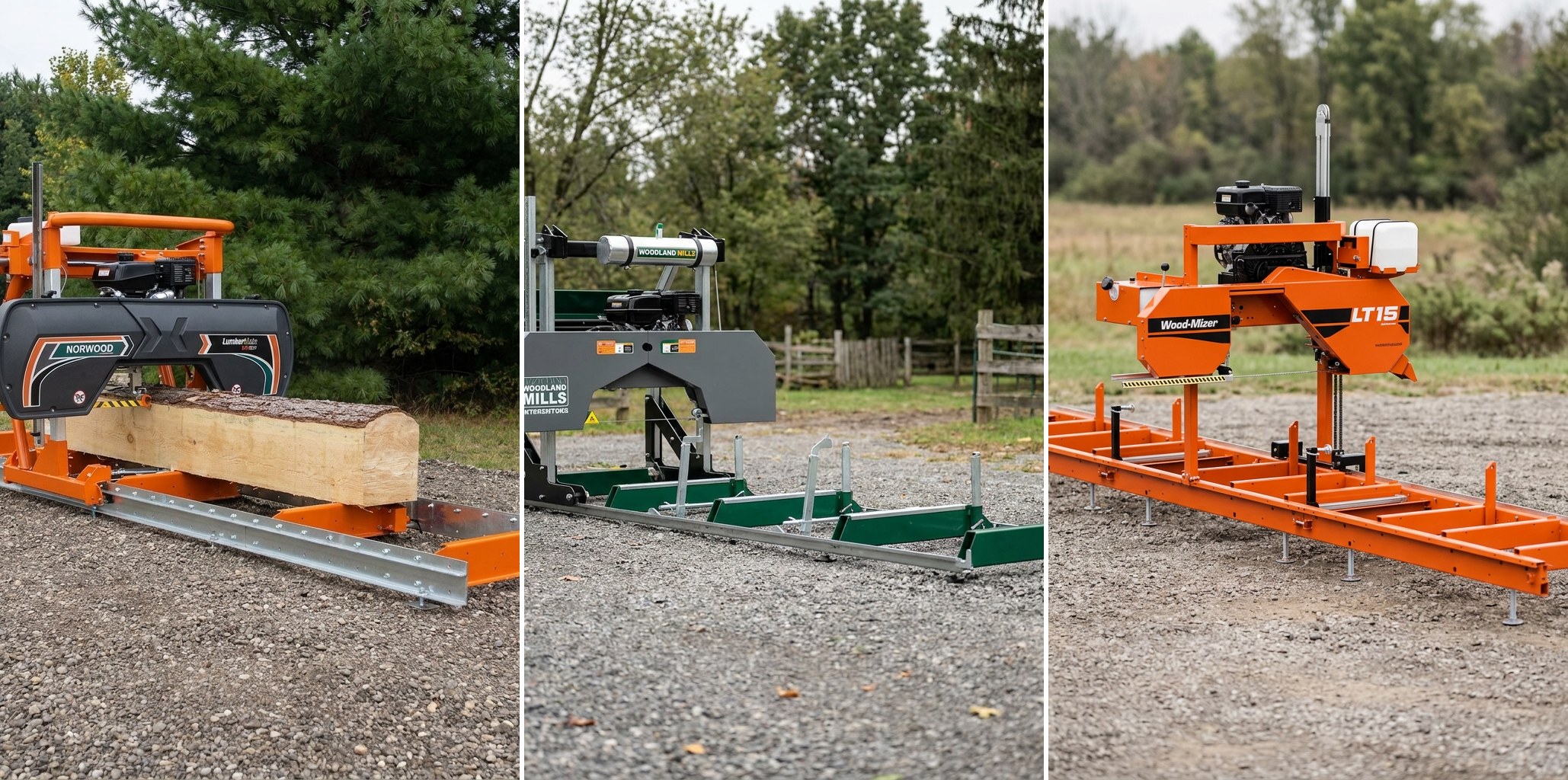
Quick Answer: There’s no single winner — it depends on what you’re buying for. Woodland Mills wins on price and value for hobbyists, Norwood wins on capacity per dollar and add-on flexibility, and Wood-Mizer wins on build quality, dealer support, and resale value. We run a Wood-Mizer LT15 at our mill and would buy it again — but if I were starting on a tight budget today, I’d look hard at the Woodland Mills HM130MAX first.
Wood-Mizer vs Norwood vs Woodland Mills is the three-way argument that never dies around any log deck, and after ten-plus years running our LT15 on upper-Midwest hardwoods — and sawing alongside neighbors who own the other two brands — I’ve got opinions grounded in actual sawdust. All three companies build good bandsaw mills. They just optimize for different buyers, and the marketing does its best to hide that. Here’s the honest head-to-head: real 2026 prices, the spec table the brochures won’t put side by side, and which mill I’d point you to for each situation.
Last Updated: August 2026 | Jason Lewis has run a Wood-Mizer LT15 for ten-plus years and saws alongside neighbors on Norwood and Woodland Mills machines — this comparison comes from shared log decks, not spec sheets alone.
The Three Brands in 60 Seconds
Wood-Mizer: The Industry Standard
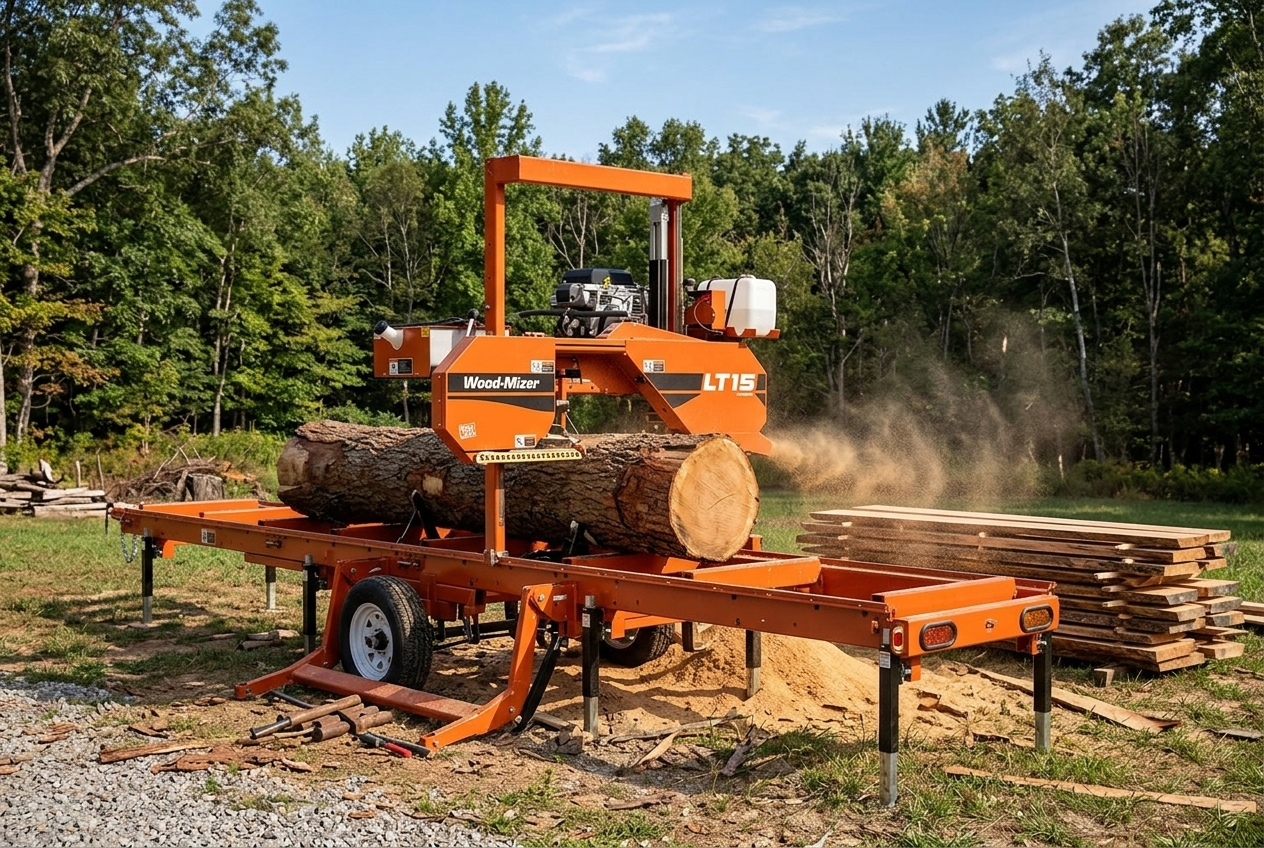
Wood-Mizer basically invented the modern portable bandmill and it shows — fit and finish, a real dealer network with service techs, and the strongest resale value in the business. Our LT15 has earned its keep for a decade with nothing but blades, belts, and routine maintenance. The trade-off is price: you pay a premium over comparable capacity from the other two, and entry models like the LT15 keep the log handling manual unless you spend up the line.
Norwood: The Tinkerer’s Mill
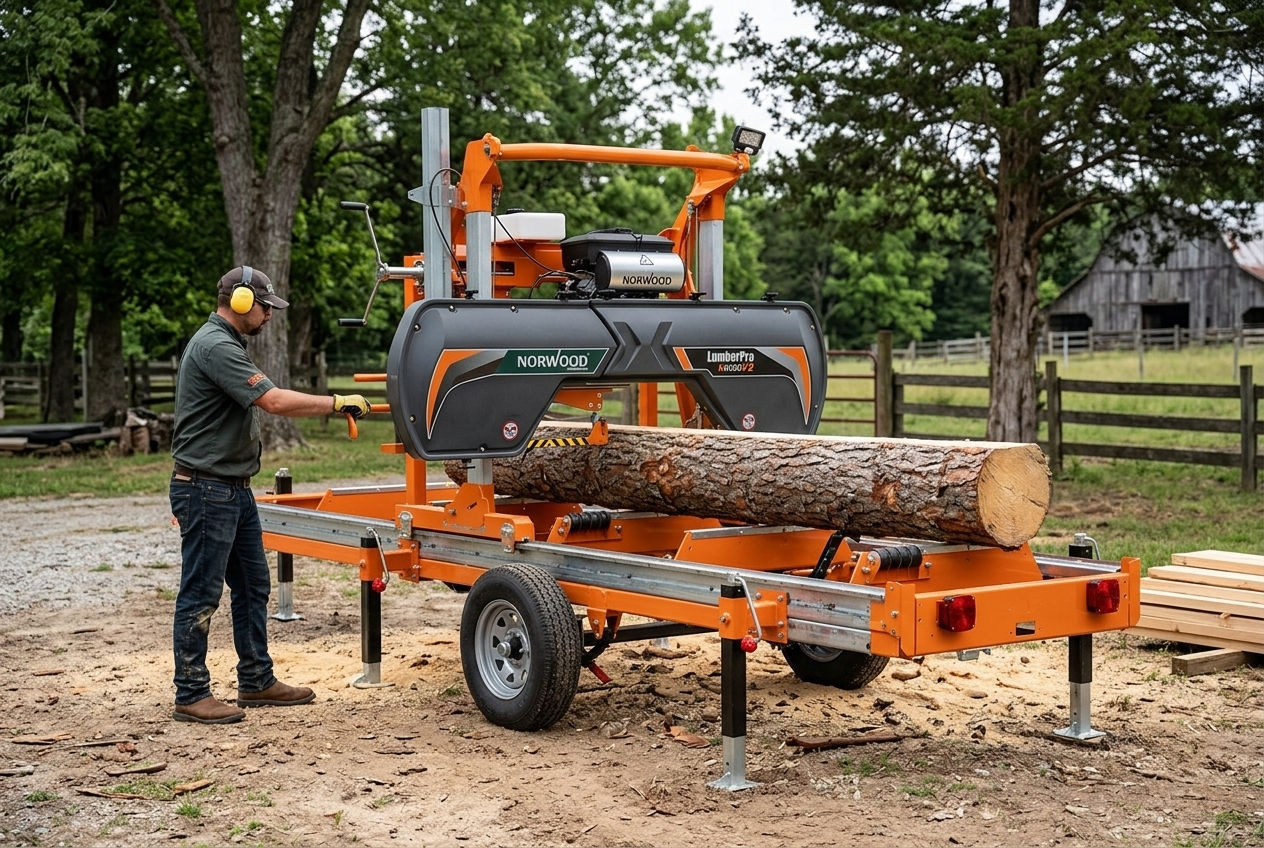
Norwood’s whole pitch is modular expandability — buy the LumberMate LM30 now, bolt on track extensions, towing kits, log loaders, even a moulder head later. Capacity per dollar is strong: a 30" log on a $6,000 mill. The honest cons: it ships knock-down on a pallet, so plan on a weekend-plus of assembly, and the manual-mill line stops short of hydraulics — you have to jump to the HD36v2/HD38 class for that.
Woodland Mills: The Value Play
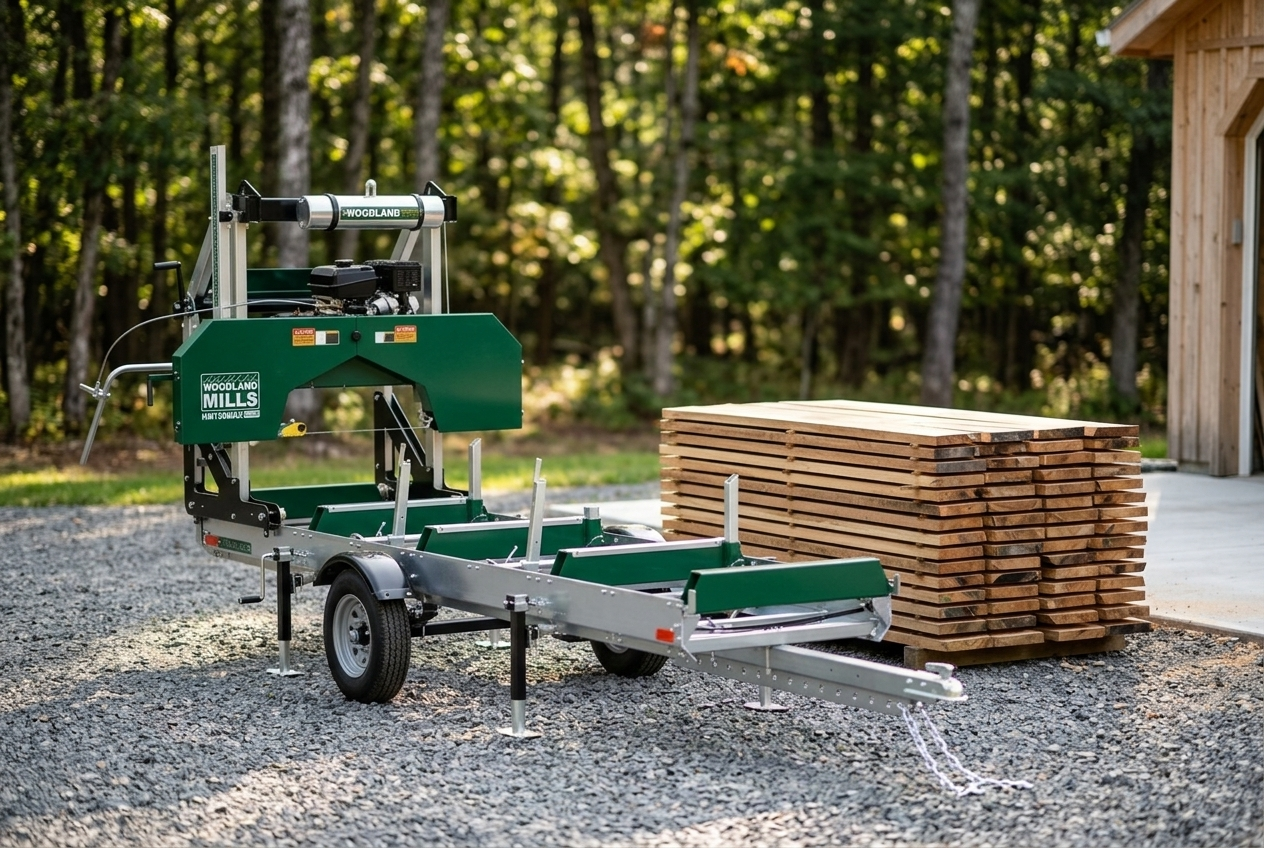
Woodland Mills changed the entry-level market. The HM126 put a real 26" bandmill under $4,000, and the HM130MAX gives you a 30" log capacity and a 14hp Kohler for thousands less than the equivalent orange or gray machine — with the longest standard warranty of the three (3 years). The cons are the flip side of the price: lighter-gauge construction than a Wood-Mizer, no dealer network (it’s direct-ship and DIY service), and resale is decent but not Wood-Mizer decent.
Head-to-Head Spec Table: LT15 vs LM30 vs HM130MAX
These are the three mills most buyers actually cross-shop in the mid-size manual class — comparable log capacity, all gas-powered, all on unlimited-length track systems. Prices are U.S. manufacturer pricing as of August 2026 (promos change — check current pricing before you order):
| Spec | Wood-Mizer LT15 | Norwood LumberMate LM30 | Woodland Mills HM130MAX |
|---|---|---|---|
| Base price (2026) | $9,895 (promo; reg. $10,895) | $5,980–$8,340 by engine | ~$5,600 mill only; $6,600–$7,600 w/ trailer |
| Max log diameter | 28" | 30" | 30" |
| Max width of cut | ~24" | 25" | 29" board / 30" live edge |
| Engine options | Gas / diesel / electric | 13½–18hp gas (B&S, Kohler, Honda, Vanguard) | 14hp Kohler, electric start |
| Log length (standard) | 17′ 8" | 12′ 9" (extendable) | 10′ 5" (extendable) |
| Hydraulics path | Yes — up the LT line | No (jump to HD36v2) | No |
| Warranty | 2 years | 2 years + 30-day money-back | 3 years (engine by Kohler) |
| Dealer / support model | Dealer network + factory | Factory direct, phone support | Direct-ship, online support |
| Resale value | Excellent | Good | Good |
Budget tier, same story compressed: the Woodland Mills HM126 (~$3,995) undercuts the Norwood LumberMan MN27 and Wood-Mizer LT15START ($6,695 promo) by a wide margin, and for a homestead mill sawing your own lumber, it’s the value pick of the whole market. Our full breakdown of what you get at each price point is in our guide to portable sawmill costs by tier.
What a Decade on the LT15 Taught Us
Here’s the experience part the spec sheets can’t show. Our LT15 has milled everything from storm-downed silver maple to 26" white oak, and the things you appreciate at year ten aren’t the things you shopped for at year one. The head tracks true after thousands of board feet. Parts show up fast because there’s a dealer two hours away. And when a buddy wanted to upgrade his mill, his used Wood-Mizer sold in four days at a price that would make a used-truck salesman blush. That’s what the premium buys: not more capacity — the table above shows Norwood and Woodland give you more inches per dollar — but fewer headaches per year and more of your money back when you sell.
That said: when I help a neighbor mill on his HM130MAX, the 30" throat and that torquey Kohler make me mutter at my own machine. And Norwood’s log rests and clamping system are legitimately clever — their patent wall is real. Nobody’s building junk here.
Which Sawmill Should You Buy?
- Hobbyist milling your own lumber, tight budget: Woodland Mills HM126 or HM130MAX. Most mill for the money, 3-year warranty, and you’ll never feel underbought sawing your own logs.
- Homesteader or part-timer who wants to grow the setup over time: Norwood LM30. The modular attachment system means the mill you buy today doesn’t cap what your operation looks like in five years.
- Anyone charging money for sawing, or planning to: Wood-Mizer LT15 or up. Customers know the name, downtime costs you real income, and the dealer network plus resale value make the premium a business expense, not a splurge.
- Planning to go hydraulic eventually: Wood-Mizer, full stop — the LT-series upgrade path is the smoothest way from manual weekend mill to production machine.
Whichever way you lean, pick the mill after you’ve defined the job — our complete guide to portable sawmills walks through matching mill class to workload, and our best portable sawmill for the money picks rank these machines against the rest of the field.
From experience: if a neighbor showed up tomorrow with $5,000, I’d point them at the Woodland Mills HM130MAX — it wins on actual mill for the money, with the 14 HP Kohler and a genuinely wide cut for the price.
Running Costs: Blades, Parts, and Downtime
The purchase price is the down payment; blades and parts are the subscription. All three mills run standard 1¼" bands that any decent blade supplier can furnish — the Norwood LM30 takes a 144" blade, our LT15 runs a 158", and Woodland’s are similarly common sizes. Expect $25–$40 per blade from the manufacturer and less from third-party suppliers, with each blade good for several sharpenings. Where the brands separate is what happens when something breaks. Wood-Mizer’s dealer network means a belt, a guide roller, or a drive part is often a drive away instead of a freight shipment. Norwood and Woodland Mills both run factory-direct parts by mail — fine for planned maintenance, painful when the mill is down mid-job with a customer’s log pile on the deck. If you saw for money, that difference is worth real dollars; if you saw for yourself, a week’s wait is an annoyance, not a crisis.
One more line item people skip: none of these manual mills include a trailer package as standard. Towing kits run roughly $1,500–$2,400 from Norwood, similar money from Wood-Mizer, and Woodland Mills sells the HM130MAX in a Woodlander trailer configuration that’s often the cheapest road-ready path of the three. Price the mill you’ll actually use — stationary on leveling feet or mobile on wheels — not the base SKU.
Beyond These Three: How Each Lineup Grows
Brand choice matters more than model choice, because your first mill usually isn’t your last. Here’s how each ladder climbs:
- Wood-Mizer: LT15START ($6,695) → LT15 → LT15WIDE → LT28/LT35 → hydraulic LT40-class production mills. The widest, smoothest upgrade path in the industry — and used Wood-Mizers hold value well enough that trading up doesn’t hurt much.
- Norwood: LumberMan MN27 → LumberMate LM30 → LumberPro HD36v2 → LumberMax HD38 (up to 27hp, hydraulics-capable). The trick with Norwood is you can also grow sideways — extensions, loaders, even a log moulder head — without changing mills.
- Woodland Mills: HM122 → HM126 → HM130MAX. The ceiling is lower — there’s no hydraulic production tier — which is exactly why it’s the right brand for buyers who know they’ll stay hobby-scale and the wrong one for buyers quietly planning a sawing business.
A useful gut check before you commit: run the numbers on what you’d actually earn or save with the mill — our breakdown of how much you can make with a portable sawmill puts real 2026 rates against each class of machine. A $4,000 mill that saws everything you need beats a $10,000 mill financed on optimism.
Frequently Asked Questions
Is Wood-Mizer worth the extra money?
If you’re sawing for income or plan to resell the mill someday, usually yes — the dealer support, durability, and resale value recover much of the premium. If you’re a hobbyist sawing a few thousand board feet a year of your own lumber, the extra spend is harder to justify against an HM130MAX or LM30.
Are Woodland Mills sawmills any good, or just cheap?
They’re genuinely good for the price — accurate, well-designed mills with a 3-year warranty, which is the longest of the three brands. The compromises are lighter construction than a Wood-Mizer, direct-ship-only support, and no path to hydraulics. For hobby and homestead use, they’re the value benchmark of the industry.
Which brand cuts the widest boards?
In this class, the Woodland Mills HM130MAX — up to 29" boards and 30" live-edge slabs from its 30" throat. The Norwood LM30 cuts to 25" wide, and the standard Wood-Mizer LT15 to about 24" (Wood-Mizer sells the LT15WIDE if you need more).
How hard is a Norwood sawmill to assemble?
Plan on a full weekend or more. Norwood ships knock-down on a pallet to cut freight costs, and the assembly manual is thorough — but it’s hundreds of parts. Owners consistently say the build teaches you the machine, which pays off at maintenance time.
What do these mills cost in 2026?
Roughly: Woodland Mills HM126 about $3,995 and HM130MAX in the $5,600–$7,600 range depending on trailer options; Norwood LM30 from $5,980 to $8,340 depending on engine; Wood-Mizer LT15START at $6,695 and LT15 at $9,895 on current promos. All three run seasonal sales, so timing your order matters.
The Bottom Line
Buy Woodland Mills for value, Norwood for flexibility, Wood-Mizer for the long haul. We’ve been happy on the orange team for ten years, but the honest truth is that the “which sawmill wins” question is really “which trade-off fits your operation” — and the operator who knows his cut list, budget, and five-year plan before ordering will be happy with any of these three. Figure out the job first, then let the table above pick the machine.