
The first question every new chainsaw miller asks is some version of “what size chainsaw do you need for milling?” — and the honest answer is that most people already own a saw that is too small for it. Crosscutting firewood takes a few seconds of full throttle. Ripping a 20-inch oak log end to end takes several minutes of full throttle with the chain buried in the wood the whole way, and that is a completely different job for the engine. I’m Jason Lewis, and I’ve run a portable mill for over ten years, mostly on upper-Midwest hardwoods; before our Wood-Mizer LT15 ever showed up, the first slabs at our place came off an Alaskan mill. Here is how we size a saw for milling, by log diameter, by species, and by how often you plan to do it.
Quick Answer: The practical minimum chainsaw size for milling is about 50cc with an 18–20 inch bar, and that only works for small logs (under 16 inches) and mostly softwood. The sweet spot for regular milling is 70–90cc, and if you mill hardwood logs over 24 inches you want 90cc or more. Bar length should be the log diameter plus 4–6 inches, because the mill’s clamps eat a few inches of bar on each end.
Last Updated: September 2026 | Jason Lewis has run a Wood-Mizer LT15 on upper-Midwest hardwoods for over ten years, and cut his first slabs on an Alaskan chainsaw mill before the band mill ever showed up.
How Many cc Do You Need for a Chainsaw Mill?
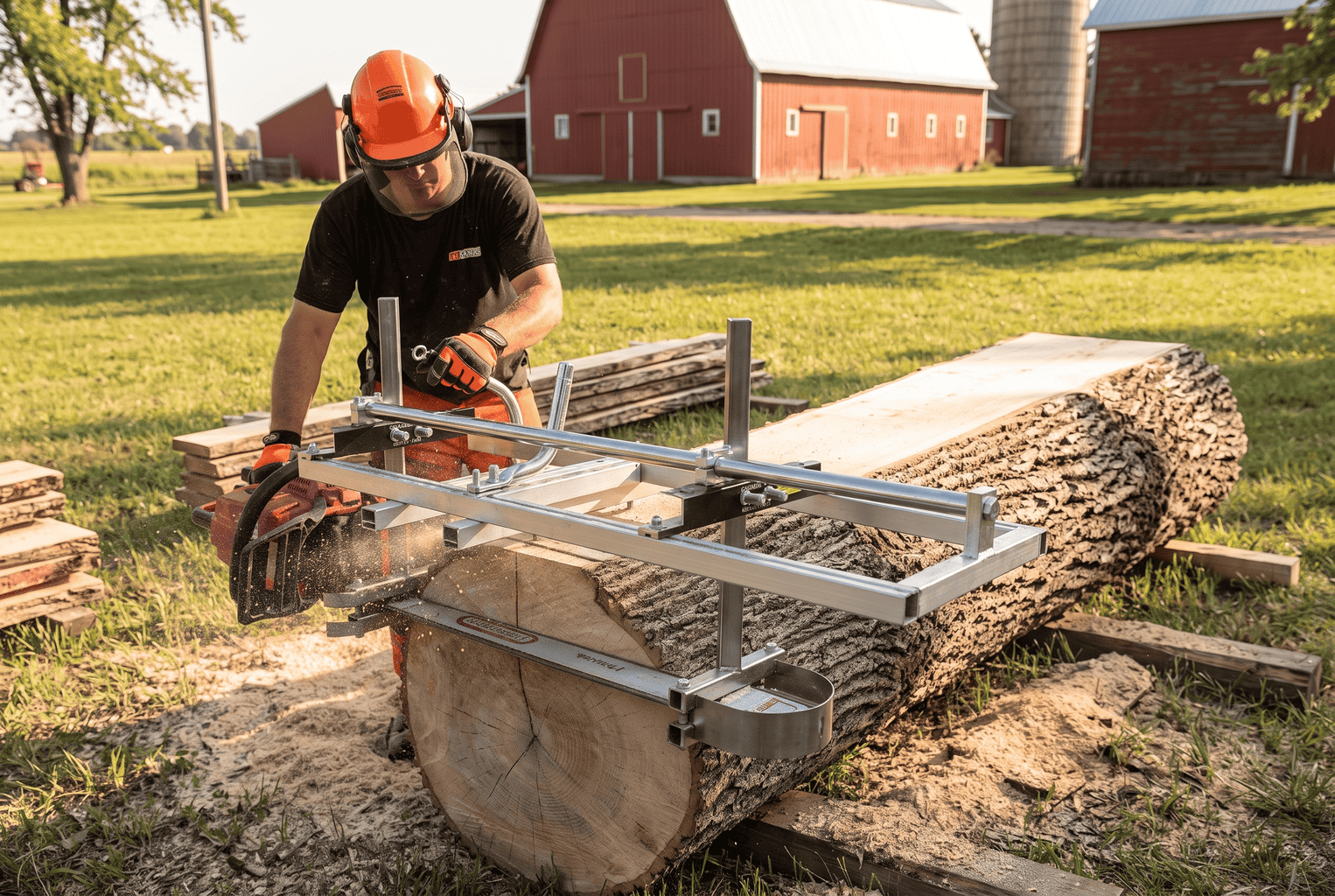
A chainsaw mill is a steel frame that clamps to the saw’s bar and rides along a guide on top of the log to rip it into slabs — the frame sets how wide you can cut, but the saw’s engine displacement sets how big a log you can actually get through.
Chainsaw engines are rated by displacement in cubic centimeters (cc), and for milling, displacement is a decent stand-in for the thing you actually care about: torque at the chain while the entire bar is in the cut. A saw that “feels plenty strong” bucking rounds can bog, overheat, and score a piston when you ask it to rip a 10-foot cut without a break.
The three size classes that matter for milling are simple:
- 50–60cc — entry level. Fine for a small-log mill, bars up to about 20 inches, softwood, and occasional use. This is the minimum Granberg lists for its small log mill, the G777, which takes a 16–20 inch bar and is about the cheapest way to find out whether you like milling — this is the same G777 on Amazon.
- 70–90cc — the milling sweet spot. Enough torque for hardwood logs up to roughly 30 inches on a 28–36 inch bar, and enough cooling capacity to run for minutes at a time without cooking. If you plan to mill more than a couple of weekends a year, start here.
- 90cc and up — big logs, long bars. For 36-inch-plus mills, bars over 36 inches, and dense hardwood, you want a 90cc-class saw at minimum. Granberg’s own guidance climbs from 60cc-plus on the 30-inch MK-IV to 90cc-plus on the 48-inch and 120cc-plus on the 60-inch and 84-inch frames.
Notice that nobody who mills regularly recommends a 40cc homeowner saw. It is not that it cannot make a cut — it will, once or twice — it is that the low-end torque and cooling are not there for sustained ripping, and you will pay for those slabs with a rebuilt or dead saw.
Chainsaw Size by Log Diameter: The Table
Here is the sizing chart we hand to people who ask. Read across from the biggest log you realistically expect to mill, not the biggest one you can imagine finding.
| Largest log diameter | Minimum saw | Comfortable saw | Bar length | Mill size (Alaskan-style) | Notes |
|---|---|---|---|---|---|
| Up to 12 in. | 50cc | 60cc | 18–20 in. | Small log mill / 24 in. | Softwood and small hardwood; occasional use |
| 12–20 in. | 60cc | 70cc | 24–28 in. | 24–30 in. | Where most hobby milling actually happens |
| 20–30 in. | 70cc | 80–90cc | 28–36 in. | 30–36 in. | Hardwood at this size wants the top of the range |
| 30–40 in. | 90cc | 100–120cc | 36–48 in. | 36–48 in. | Consider a double-ended bar and second powerhead |
| Over 40 in. | 120cc | 120cc + helper saw | 48 in. and up | 56–84 in. | Specialty work; most people should hire a bandsaw mill |
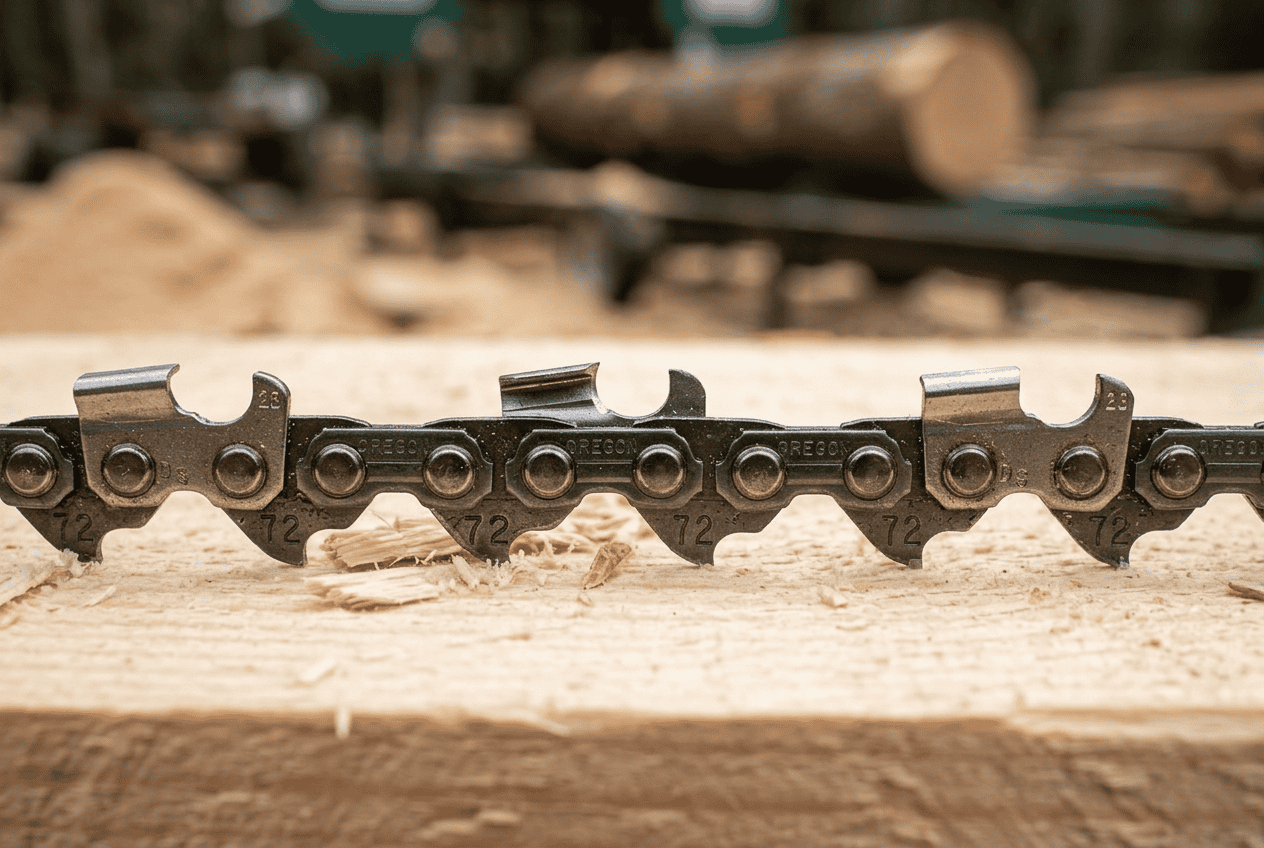
Two things the table quietly assumes: you are running a ripping chain, and the chain is sharp. The chain we point people to is the Granberg G7290 ripping loop, 3/8 pitch and .050 gauge, ground at 10 degrees from the factory — this is the one on Amazon, listed as the 24-inch, 84-drive-link loop; the same chain comes in other lengths, so match the drive-link count to your bar before ordering. A dull crosscut chain will make a 90cc saw feel like a 50.
Why Milling Needs a Bigger Saw Than Firewood Does
When you buck a round, the bar is in the wood for a couple of seconds and only part of the bar is cutting. On a mill, the entire bar is engaged, the cut is with the grain (which is slower and produces long, stringy chips that clog), and a single pass on a 10-foot log can run three to five minutes at wide-open throttle. Three things happen to the saw:
- Heat builds. The engine never gets the cooling breaks it gets during normal cutting. Bigger saws have more fin area and more air moving through the cylinder, which is why displacement tracks so well with milling ability.
- Torque matters more than RPM. A small saw makes its power high in the rev range. In a rip cut with a long bar, chain speed drops and you need torque to keep the cutters biting instead of rubbing.
- The oiler runs out of reach. Past about 28 inches of bar, the stock oiler cannot keep the far end of the chain wet, which means more friction and more heat. Big saws have higher-output oilers, and anything over 36 inches wants an auxiliary oiler at the bar tip.
This is also why the chainsaw milling guide spends so much time on chain and bar setup rather than horsepower. The saw is only one part of the system.
Bar Length: Log Diameter Plus Four to Six Inches
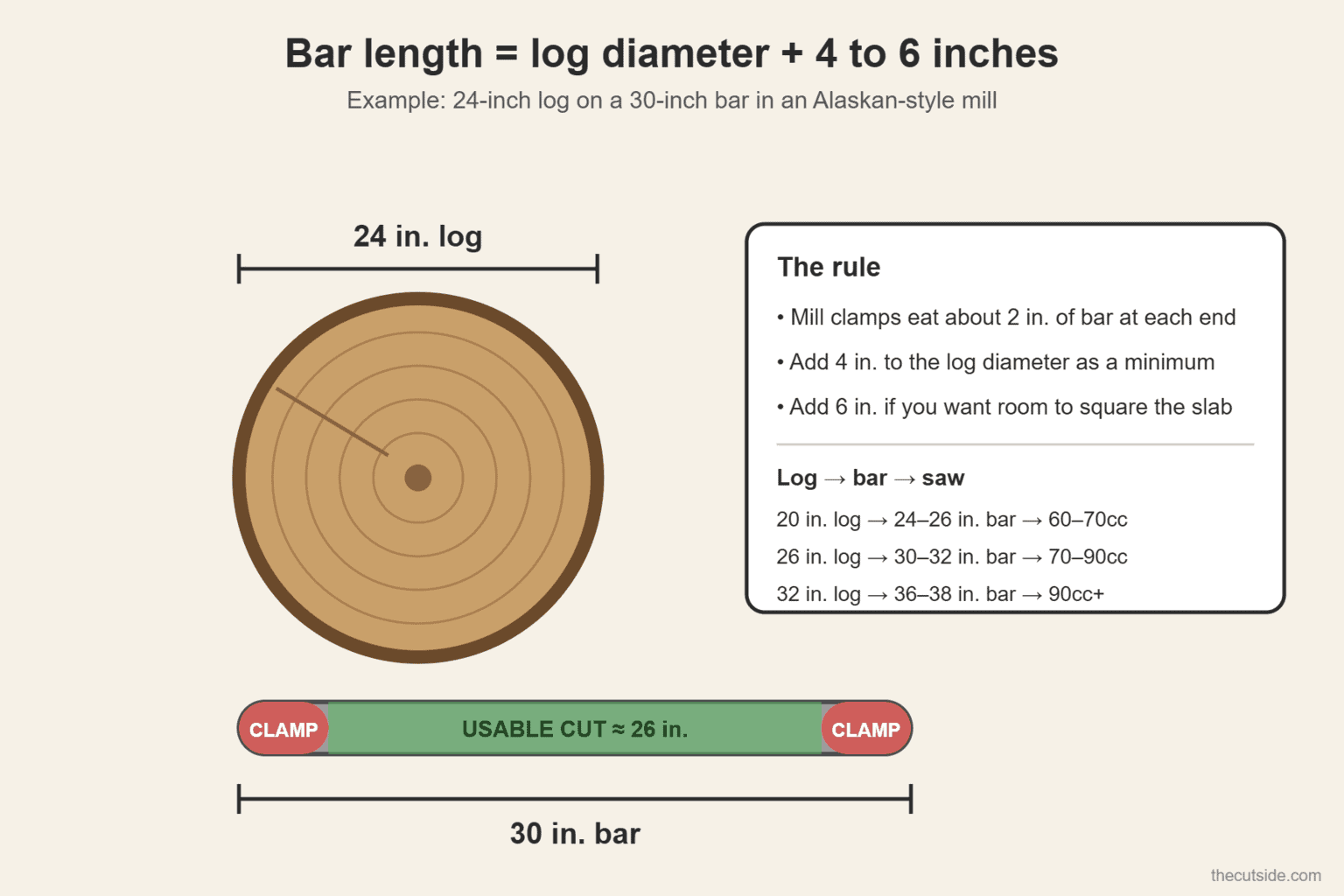
Bar length sets the widest slab you can cut, but you do not get the whole bar. On an Alaskan-style mill the clamps grab the bar near the powerhead and near the tip, and each one eats about two inches of usable length. So a 36-inch bar on a 36-inch mill nets you roughly 32 inches of cut. (The 36-inch Granberg MKIV, model G778-36 — this is the same mill on Amazon — is the frame that 32-inch figure is based on, clamps included.) The rule of thumb we use:
Minimum bar length = largest log diameter + 4 inches (6 inches if you want room to square the slab later).
A few practical examples:
- 20-inch log → 24–26 inch bar, 24-inch mill, 60–70cc saw
- 26-inch log → 30–32 inch bar, 30–36 inch mill, 70–90cc saw
- 32-inch log → 36–38 inch bar, 36-inch mill, 90cc+ saw
The mistake we see most is buying the bar for the biggest log you might ever find and then running it on a 60cc saw. A long bar on a small powerhead is slow, it starves for oil at the tip, and the chain wanders because there is not enough chain speed to keep the cut straight. Buy the bar for the logs you actually have, and if you get a monster, borrow a bigger saw or bring in a portable bandsaw mill.
Hardwood vs Softwood: Bump Up a Class
Every cc recommendation you read online assumes average wood. Up here we mostly mill red oak, white oak, hard maple, ash, and the occasional walnut, and every one of those is a different animal from a pine or cottonwood log of the same diameter. Density roughly doubles between soft pine and white oak, and so does the load on the saw.
Our rule: if the log is a dense hardwood, size the saw as if the log were one class larger. A 20-inch white oak wants the saw you would use on a 26-inch pine. A 60cc saw that is perfectly happy in 20-inch pine will bog, heat up, and glaze its chain in 20-inch oak.
Green wood mills easier than dry, and frozen hardwood in a Minnesota January is the hardest thing you will ever put a chainsaw through. If you mill through the winter like we do, that is one more reason to be at the top of the cc range instead of the bottom.
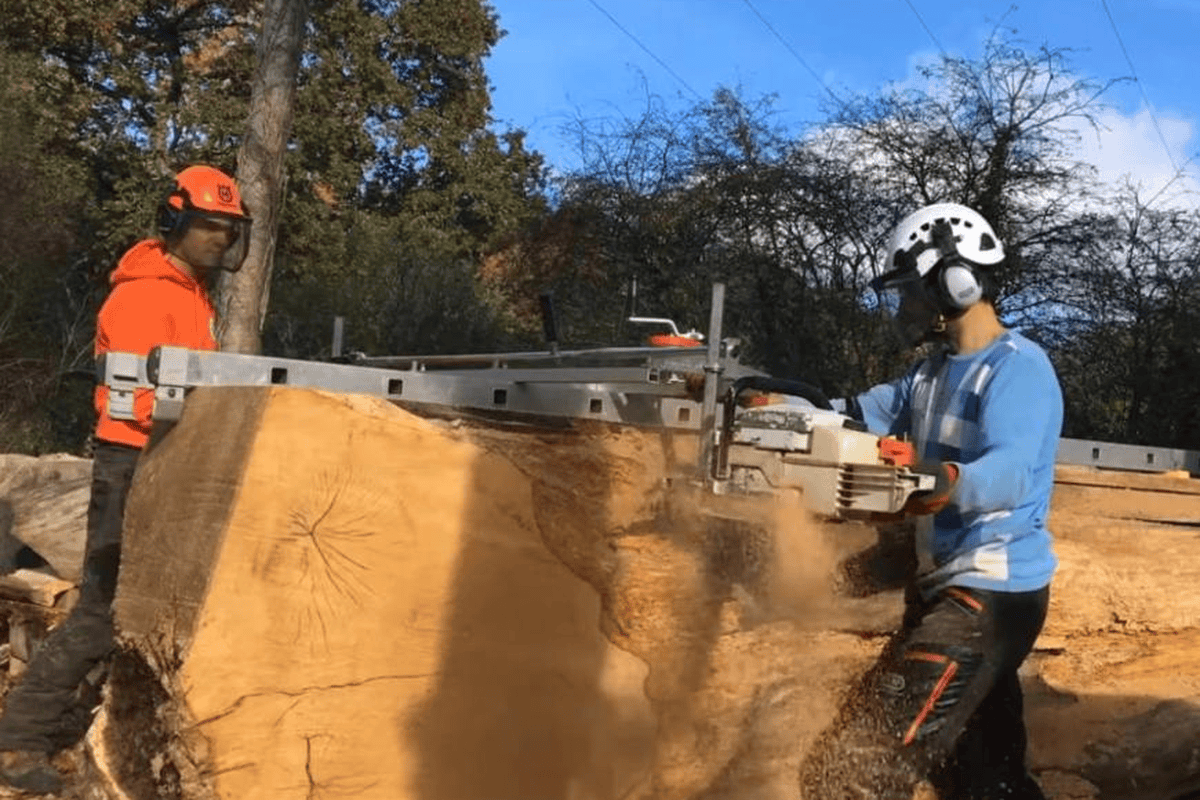
Saws That Fit Each Size Class
These are the powerheads that come up over and over in milling circles, grouped by class. Displacements are the manufacturers’ published figures; check the current spec sheet before you buy, because models get revised.
| Class | Examples (displacement) | Realistic milling range |
|---|---|---|
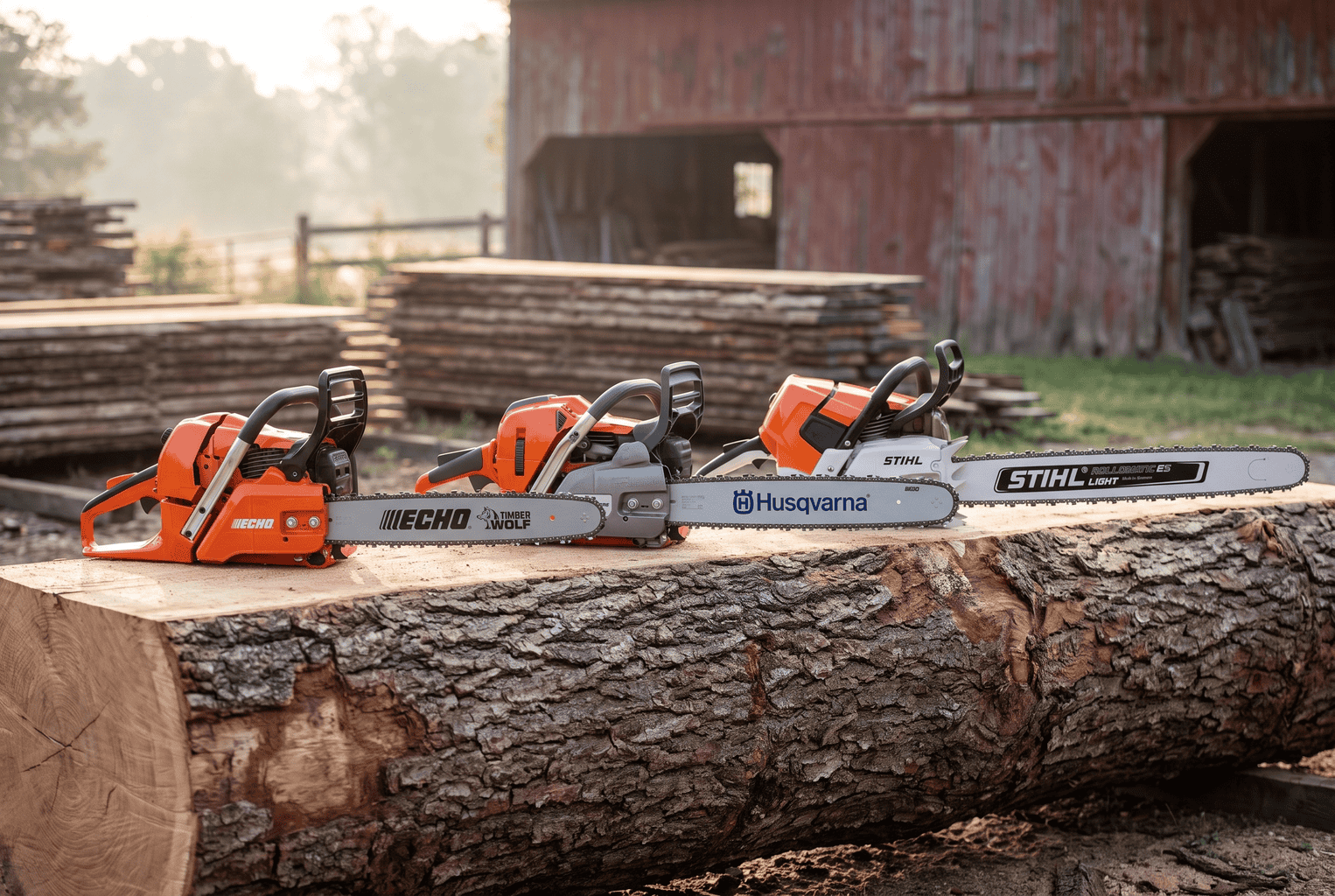
| 50–65cc entry | Echo CS-590 Timber Wolf (59.8cc) · Husqvarna 460 Rancher (60.3cc) · Stihl MS 391 (64.1cc) | Logs to about 16 in., 20-inch bar, softwood and light hardwood, occasional use |
| 70–80cc sweet spot | Husqvarna 572 XP (70.6cc) · Stihl MS 462 (72.2cc) · Echo CS-7310P (73.5cc) · Stihl MS 500i (79.2cc) | Logs to about 28 in. in hardwood, 28–32 inch bar, regular weekend milling |
| 90cc big-log class | Stihl MS 661 (91.1cc) · Husqvarna 592 XP (92.7cc) | Logs to about 36 in. in hardwood, 36–42 inch bar, frequent milling |
| 120cc specialty | Stihl MS 881 (121.8cc) · Husqvarna 3120 XP (118.8cc) | Slabbing logs 40 in. and up on 48–60 inch bars |
A few notes from running these. The 70cc pro saws are the best value in milling because they are also excellent felling and bucking saws, so the money is not tied up in a milling-only tool. The 90cc saws are heavy — a bare MS 661 is around 16.5 pounds before bar, chain, fuel, and the mill frame — and that weight is real when you are pushing it down a log for an hour. Stihl is dealer-only, so if you are shopping online the Echo and Husqvarna models are the ones you will actually find; the CS-590 Timber Wolf with the 20-inch bar is the entry-class saw that shows up most, and this is the same saw on Amazon — a 59.8cc engine at about 13 pounds dry, which is why it gets recommended for small-log mills. Our full breakdown by model is in best chainsaws for milling lumber.
Can You Mill With a Smaller Chainsaw?
Yes, within limits. If all you own is a 50cc saw and you want to try milling before spending real money, here is how to make it work without killing the saw:
- Keep the bar at 18–20 inches and use a small log mill or a 24-inch frame with the clamps pulled in.
- Stick to logs under 14 inches and start with softwood — pine, basswood, cottonwood, poplar.
- Run a ripping chain and sharpen it every tank of fuel. A sharp chain is the single biggest favor you can do a small saw. A bar-mounted guide like the Granberg G106B File-N-Joint holds the file at a repeatable 10-degree angle, which is the hard part of touching up ripping chain by hand — this is the one on Amazon.
- Let the saw idle for a minute between cuts and never lean on it. If the RPM sags, back off the feed; forcing it is how pistons get scored.
- Run the richest fuel mix the manual allows and quality bar oil. Small saws milling are right on the edge of their cooling capacity. Use a real 2-stroke oil, not bargain-bin mix; for the Echo saws that means their Red Armor oil in the 2.6-ounce bottles, one per gallon at 50:1 — a 12-pack like this on Amazon lasts a season of weekend milling.
That gets you a few slabs and tells you whether you like milling. It does not make a 50cc saw a milling saw. Most people who start this way buy a 70cc-class saw within the first year, which is fine — that is the saw they should have bought anyway, and now they know why.
Bigger Is Not Always Better
The other mistake is going straight to a 120cc saw for 20-inch logs. A 3120 XP or MS 881 is a specialty tool: it is heavy, thirsty, expensive to maintain, and miserable to use for anything but milling. If your logs top out at 30 inches, a 90cc saw is faster in the cut per dollar and per pound, and a 70–80cc saw with a sharp ripping chain will get it done on most days. Match the saw to your logs, not to the biggest bar Granberg sells.
What We Actually Run
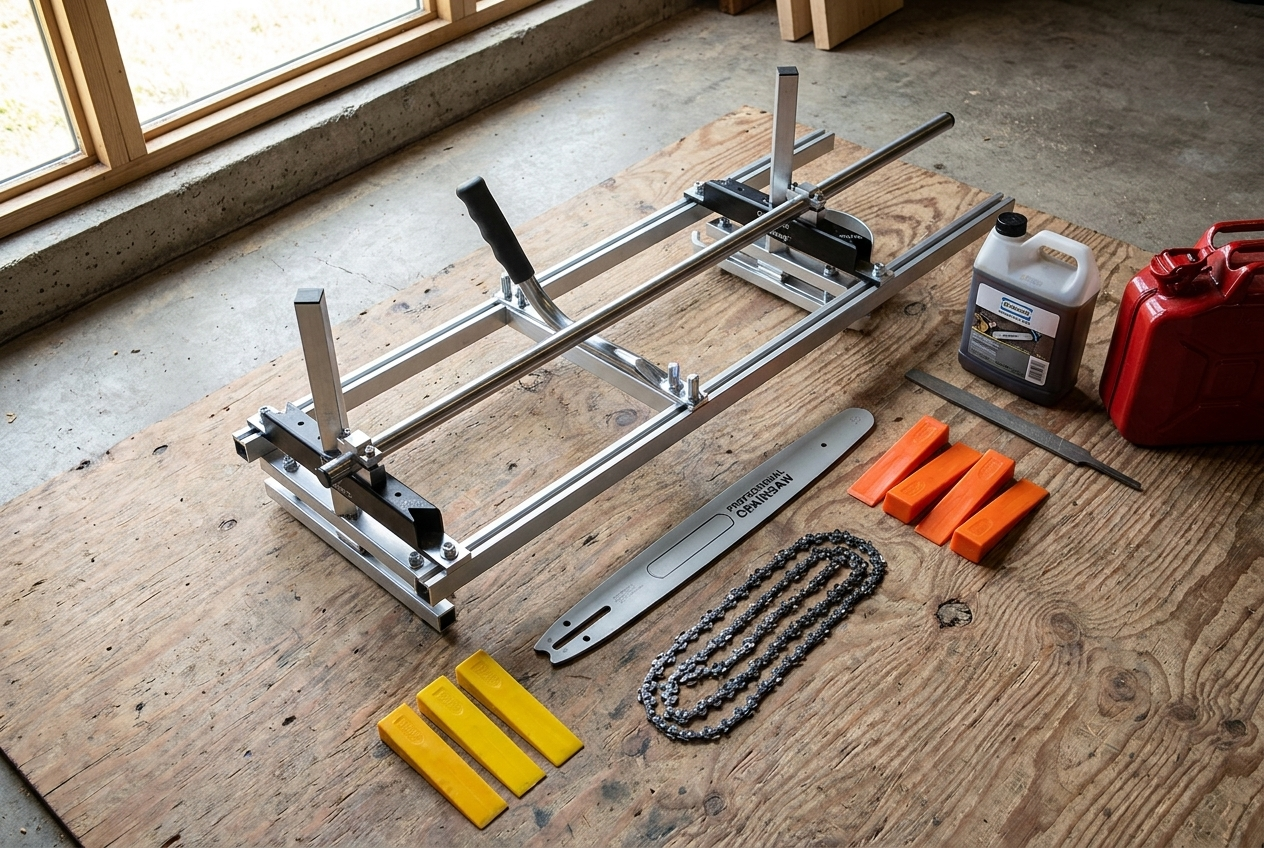
From experience: Before the LT15, our Alaskan saw was a Stihl MS 660 with a 30-inch and a 36-inch bar, and I’ll be honest, I was usually too lazy to swap up to the 36 unless I had to. The biggest log I put the 36 through was a 38–40 incher, and even then I had to take it apart in slabs the way a sawmill would, because the clamps eat enough bar that a 36 won’t reach across a log that size in one pass.
That is the bar-length rule in real life: the 36-inch bar is a 32-inch cut once the mill is clamped on, and a 90cc saw is what made those passes possible at all. Today the Alaskan mostly comes out for logs too big or too ugly to load on the LT15, and for the first slabbing cut on a crotch or a burl; for that work a 90cc saw earns its weight. If you are setting one up for the first time, our Alaskan mill first-cut setup guide covers the rails, wedging, and feed rate. If you are cross-shopping mill frames, the Granberg MKIV vs cheap mills comparison covers what the frame itself needs from the saw.
Frequently Asked Questions
How many cc do you need for a chainsaw mill?
A minimum of about 50cc for small logs and softwood, 70–90cc for regular milling of logs up to about 30 inches, and 90cc or more for hardwood logs over 30 inches or bars longer than 36 inches. Granberg rates its small log mill for 50cc-plus saws and its larger MK-IV frames for 60cc, 90cc, and 120cc-plus as the frame gets wider.
Can you mill lumber with a 50cc chainsaw?
Yes, for small logs (under about 14 inches), softwood, and occasional use, with an 18–20 inch bar and a sharp ripping chain. Keep the feed light, let the saw cool between passes, and do not expect it to handle oak. It is a way to try milling, not a milling setup.
What bar length do I need to mill a 24-inch log?
A 28–30 inch bar. The mill clamps take about two inches off each end of the bar, so a 28-inch bar nets roughly 24 inches of cut on a 30-inch Alaskan frame. Pair it with a 70cc or larger saw for hardwood.
Is a 60cc chainsaw enough for milling hardwood?
For hardwood logs up to about 16 inches, a 60cc saw with a 20–24 inch bar and ripping chain will do the job with patience. Beyond that it will bog and run hot. For oak, maple, or ash over 16 inches, step up to a 70cc-class saw.
Does milling wear out a chainsaw faster?
Yes. Sustained full-throttle ripping runs the engine hotter and longer than any other chainsaw job. A saw sized correctly for the logs, run with a sharp ripping chain, clean air filter, and good bar oil, will last for years of milling. An undersized saw pushed through big hardwood can score a piston in a single season.
The Bottom Line
If you take one number from this: 70cc. That is the smallest saw we would tell a friend to buy if they are serious about milling, and it is also a saw they will use for everything else. Go to 90cc when the logs pass 30 inches or the wood is consistently dense hardwood, and stay at 50–60cc only if you are testing the water on small softwood logs. Size the bar to the log plus a few inches, run ripping chain, and read our chainsaw sawmill safety guide before the first cut — a saw big enough to mill is a saw big enough to hurt you in a hurry. Chaps are not optional with a 70cc saw; Husqvarna’s Technical Apron Wrap chaps are the five-layer wrap-around kind that protect the back of the calf too, and this is the same pair on Amazon.
Jason Lewis has run a Wood-Mizer LT15 on upper-Midwest hardwoods for over ten years and cut his first slabs on an Alaskan chainsaw mill before the band mill ever showed up.