
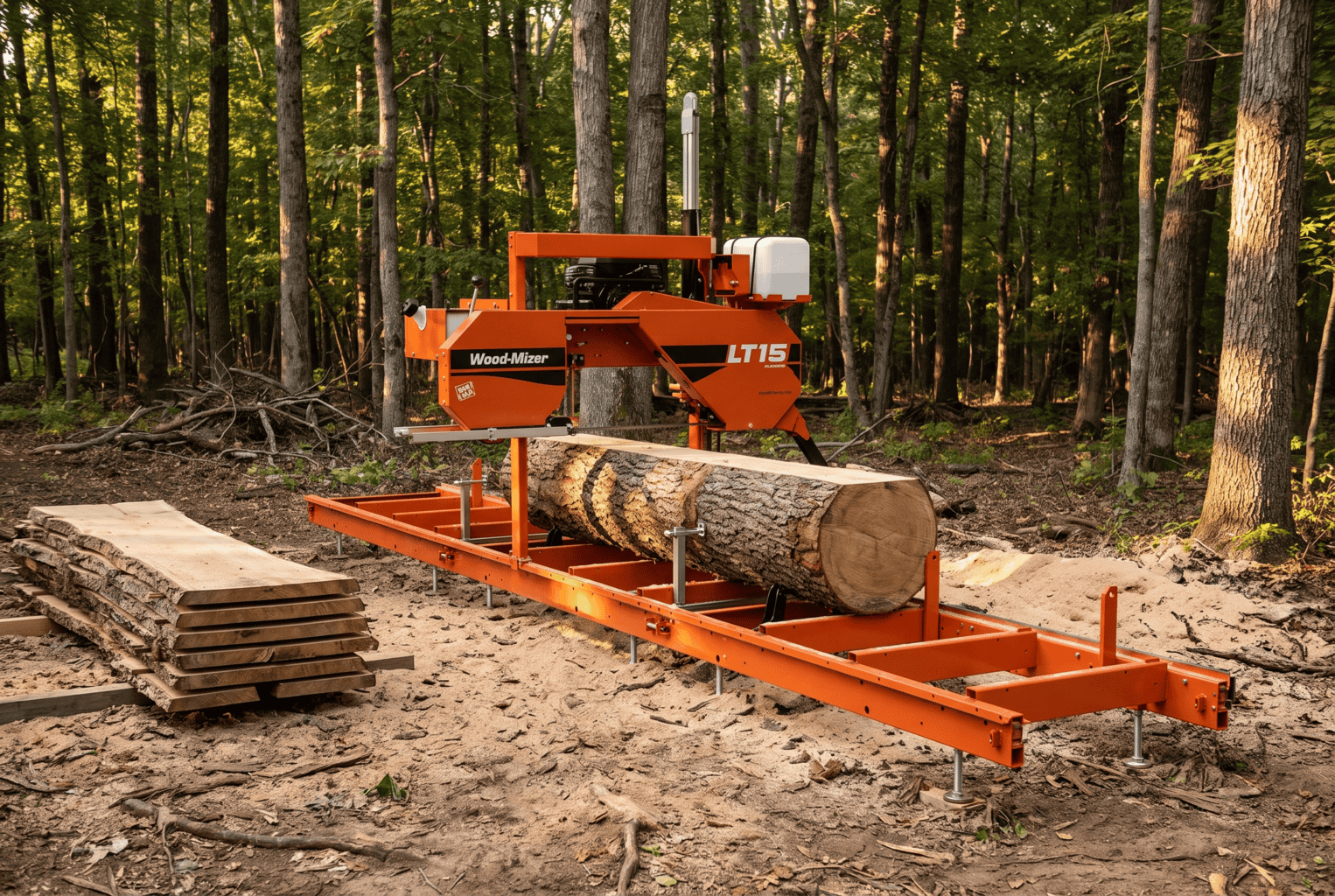
Quick Verdict: The Wood-Mizer LT15 is the best manual portable sawmill you can buy if you want mill-grade lumber without stepping into hydraulic-mill money. It starts at $7,695 for the LT15START and $10,895 for the full LT15, cuts logs up to 32″ in diameter into boards up to 30″ wide, and holds thickness accuracy that a $3,000 mill simply can’t match. Its one real weakness is that everything — feed, up/down, clamping, log turning — is done by hand.
The Wood-Mizer LT15 is a manual walk-along bandsaw portable sawmill that cuts logs up to 32″ in diameter into boards up to 30″ wide — the entry point into Wood-Mizer’s U.S.-built mill line, built on a design the company has refined since 1982.
We’ve been running an LT15 in the upper Midwest for over a decade, mostly through white oak, hard maple, black walnut and whatever storm-fall lands in the yard. It is the mill that taught us what a straight board is supposed to look like. It’s also the mill that has us reaching for the peavey about four hundred times a day. This review is the honest version — what the LT15 does better than anything at its price, what it costs once you’re actually sawing, and the specific point where you should stop reading and go price an LT35 instead.
If you’re still deciding on a category rather than a model, start with our complete guide to portable sawmills and then come back here.
Last Updated: August 2026 | Jason Lewis has spent ten-plus years running a Wood-Mizer LT15 in the upper Midwest, milling white oak, hard maple, black walnut and storm-fall — this review is written off that mill, not off a spec sheet.
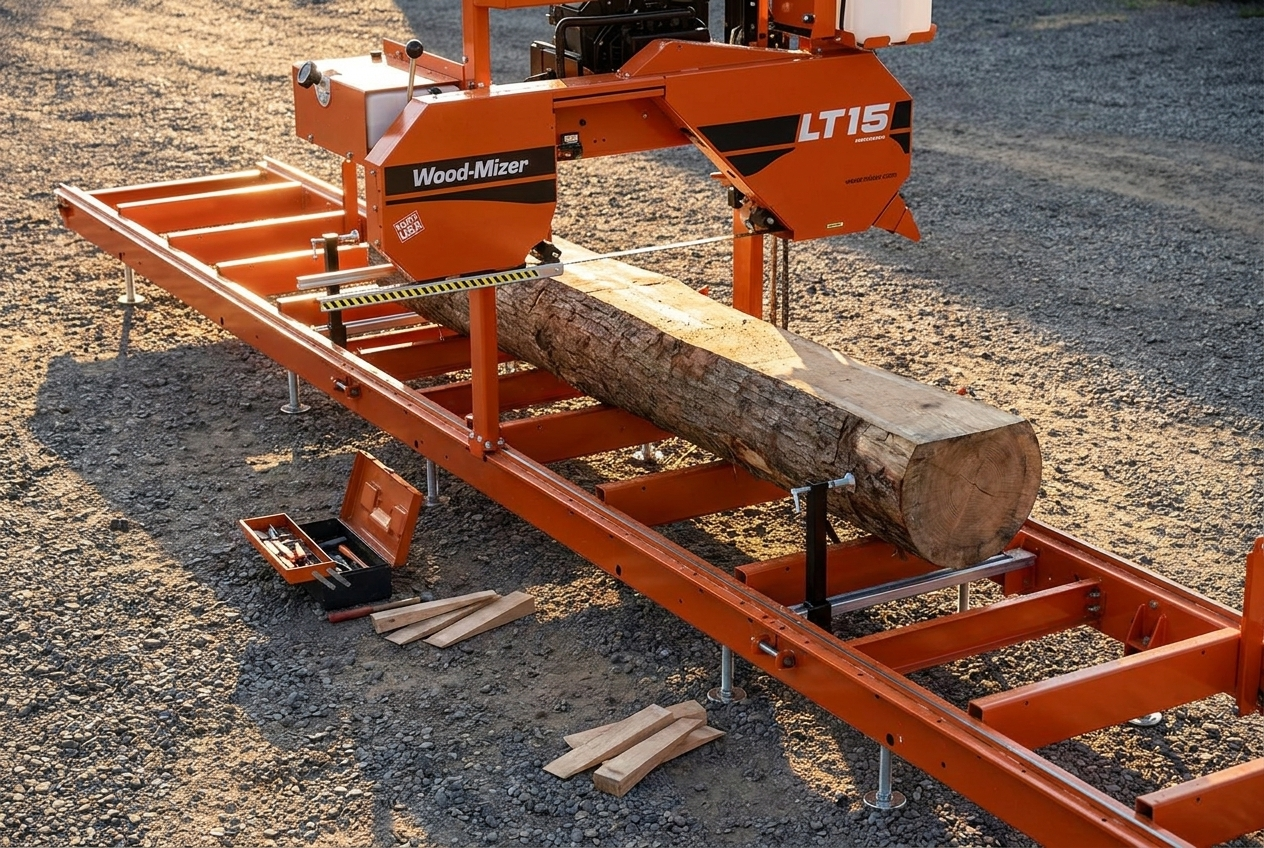
Wood-Mizer LT15 Quick Verdict Box
| Our rating | 4.5 / 5 for manual mills |
| Price (mill only) | $7,695 (LT15START) · $10,895 (LT15) · $13,195 (LT15WIDE) |
| Max log diameter | 32″ (39″ on the WIDE) |
| Max width of cut | 30″ (39″ on the WIDE) |
| Rated production | Up to 320 board feet/hour |
| Best for | Homesteaders, woodworkers, part-time custom sawyers, anyone milling 5,000–40,000 BF a year |
| Skip it if | You’re sawing full-time for income, handling 30″+ logs daily, or physically can’t turn logs by hand |
| Warranty | 2 years, plus a 30-day money-back guarantee |
What the LT15 Actually Is
The LT15 is a manual bandsaw mill built on a welded steel box-bed frame. The saw head rides the bed on four cam-adjustable rollers; you push it through the log by hand (or crank it, or add the electric power feed), and you raise and lower the head with a hand crank against a scale. There is no setworks, no hydraulics, no operator seat. It’s a walk-along push-feed mill, and Wood-Mizer has been refining that same basic design since 1982.
What you’re paying for is not features. You’re paying for the bed, the head rigidity, and the 19″ belted blade wheels. Jason Lewis, who’s operated portable mills for more than ten years, puts it this way: a cheap mill will cut a board, but the LT15 will cut a hundred boards that are all the same thickness. That repeatability is the entire reason this mill costs what it does.
Wood-Mizer LT15 Specs That Actually Matter
| Spec | LT15 | What it means at the mill |
|---|---|---|
| Max log diameter | 32″ | Handles almost any yard tree; big veneer-grade butt logs still need splitting |
| Max width of cut | 30″ | Live-edge slabs up to 30″ wide in one pass |
| Max cant width | 23″ | The real limit once you’ve squared the log |
| Max depth of cut | 10 1/2″ | Sets how tall a cant you can face before flipping |
| Max log length | 17′ 8″ (unlimited with 6′ 8″ bed extensions) | Timber-frame lengths are possible, but you’re buying track |
| Max log weight | 4,000 lbs | Bed capacity, not your ability to roll it |
| Production rate | Up to 320 BF/hr | Best-case, straight softwood, helper loading. Plan on far less — see below |
| Blade | 158″ x 1 1/4″ x .042″ | Common size, cheap, widely available |
| Blade wheels | 19″ belted | Big wheels = less blade fatigue = longer blade life |
| Power options | 19HP or 25HP Kohler gas; 10HP Yanmar or 17HP Kohler diesel; 10HP electric (1PH/3PH) | 25HP gas for hardwood; electric only if you’re milling indoors |
| Blade lube | 5-gal water tank, manual valve | Works fine; you will forget to turn it on |
About that 320 BF/hour number: it’s a spec-sheet ceiling, not a workday. On our LT15 with the 25HP gas engine, one person working alone with a cant hook averages closer to 100–150 board feet per hour in hardwood once you count log loading, turning, blade changes and stacking. With a second set of hands and a tractor with forks, 200–250 BF/hr is realistic. If you’re building an income model off this mill, use the real numbers — we walk through the math in how much you can make with a portable sawmill, and you can check your own log yield with our board foot calculator.
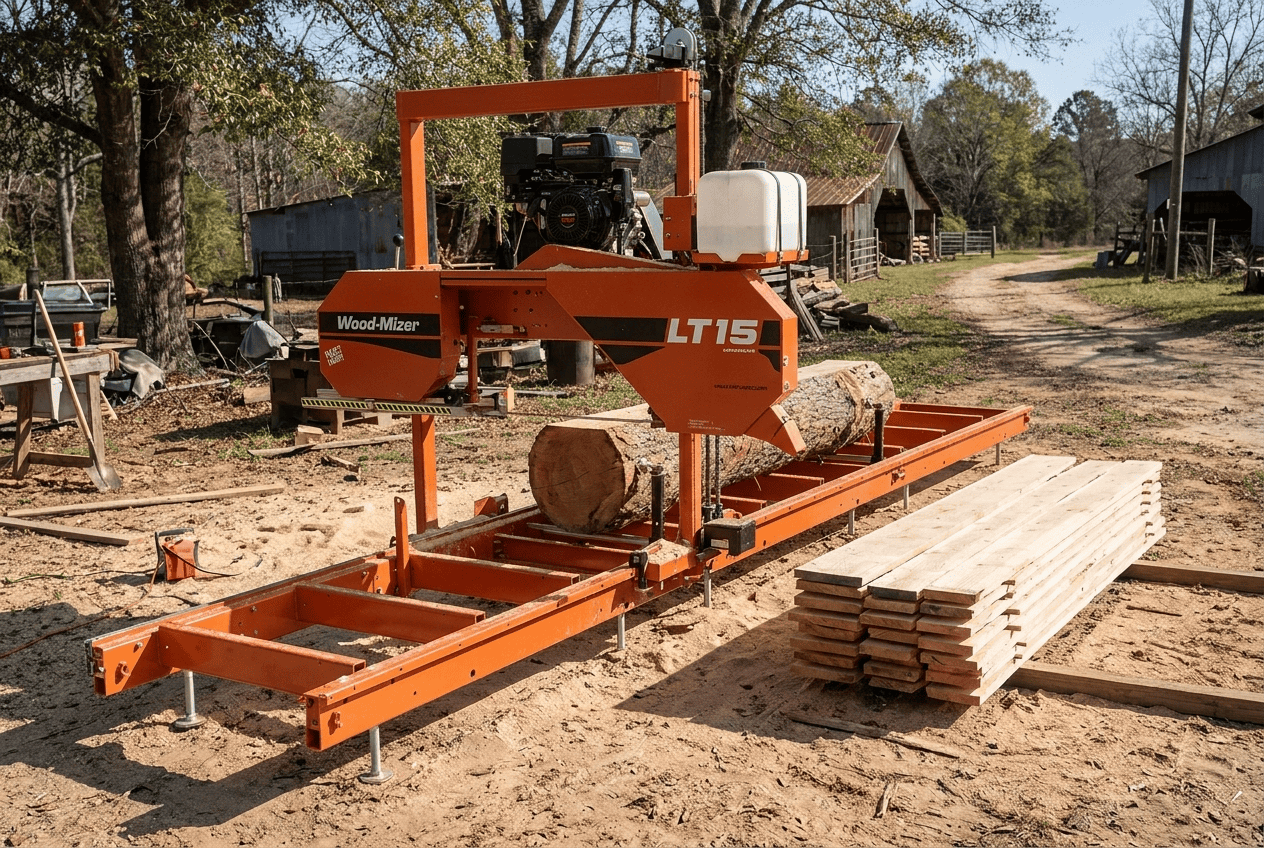
The LT15 Lineup: START vs LT15 vs WIDE
Three mills share the LT15 badge and they are not the same machine. The START is a shorter, lighter, lower-capacity entry point. The standard LT15 is the one most people mean. The WIDE is a different frame built around bigger wheels and a wider cut.
| Model | Price (mill only) | Max log dia. | Max cut width | Who it’s for |
|---|---|---|---|---|
| LT15START | $7,695 | 28″ | 26″ | First mill, occasional milling, tight budget |
| LT15 | $10,895 | 32″ | 30″ | The sweet spot for most operators |
| LT15WIDE | $13,195 | 41″ | 39″ | Slab work, big urban hardwood, wide furniture stock |
| LT15 + GO Trailer | $13,690 | 32″ | 30″ | Custom sawing at customer sites |
| LT15WIDE + GO Trailer | $16,690 | 41″ | 39″ | Mobile slab sawing as a business |
Our take: if slabs are more than an occasional job, jump to the WIDE now. Cut capacity is the one thing you cannot bolt on later. Everything else — power feed, toeboards, bed extensions, trailer — is an upgrade you can buy in year three. For a cross-brand look at where these prices sit, see our Wood-Mizer vs Norwood vs Woodland Mills comparison.
What It Really Costs to Start Sawing
Nobody sawyer-ready walks away with just the mill. Here’s an honest out-the-door build for a standard LT15 with the 25HP gas engine, based on Wood-Mizer’s current option pricing.
| Item | Cost | Skip it? |
|---|---|---|
| LT15 mill | $10,895 | No |
| Freight | $399 | Only with free factory pickup |
| 15-pack of blades | ~$395 | No — buy blades in packs, always |
| Crank feed | $336 | Yes, if you buy the power feed instead |
| Power feed (12V, variable to 90 fpm) | $1,495 | Optional year one, mandatory by year two |
| Toeboards | $545 | No — taper sawing without them is miserable |
| Pro Package | $665 | Yes, if budget is tight |
| GO Trailer | $2,995 | Yes, unless you’re sawing off-site |
| Realistic stationary build | ~$13,700 | Mill, freight, blades, power feed, toeboards |
| Mobile business build | ~$17,400 | Add the GO Trailer |
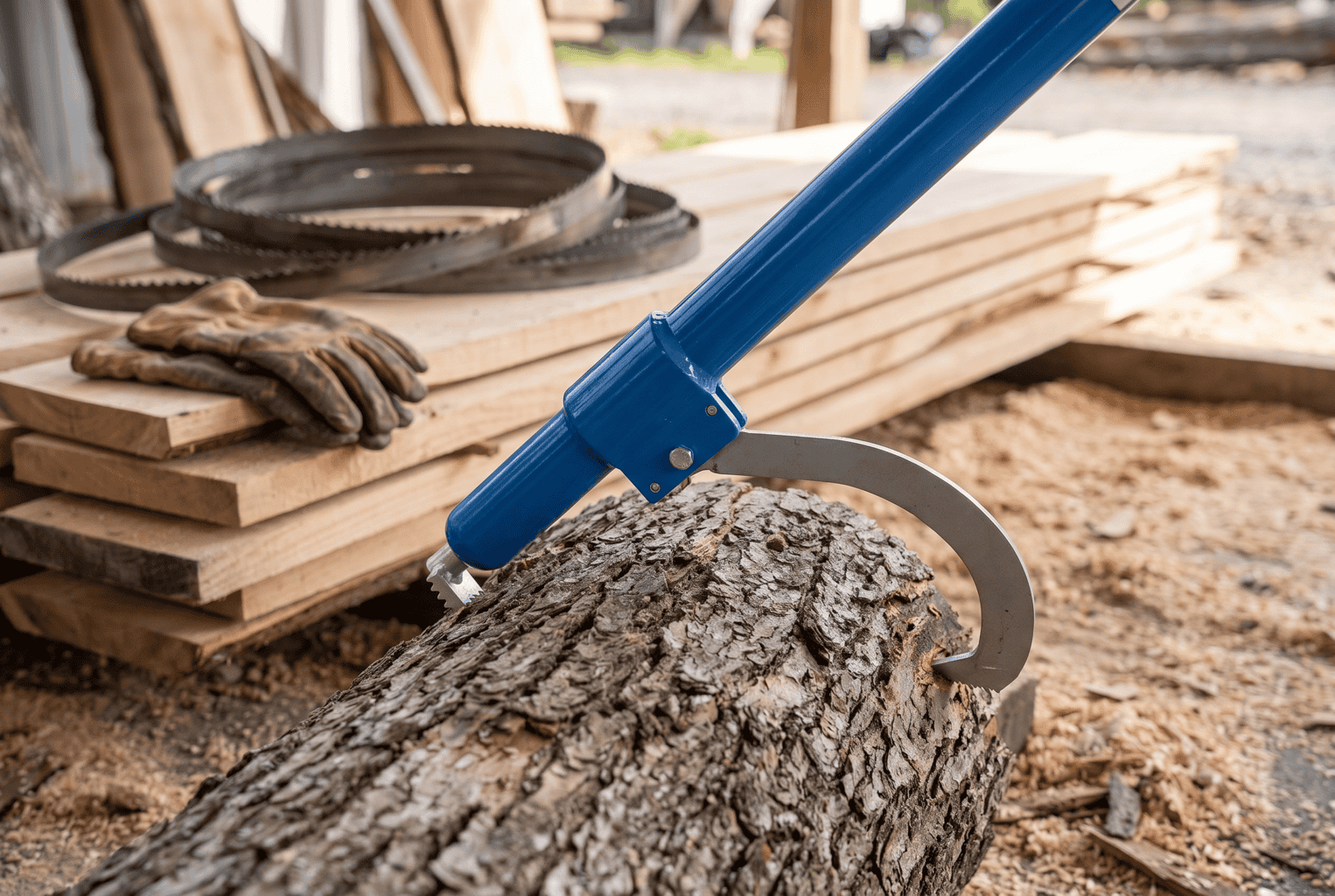
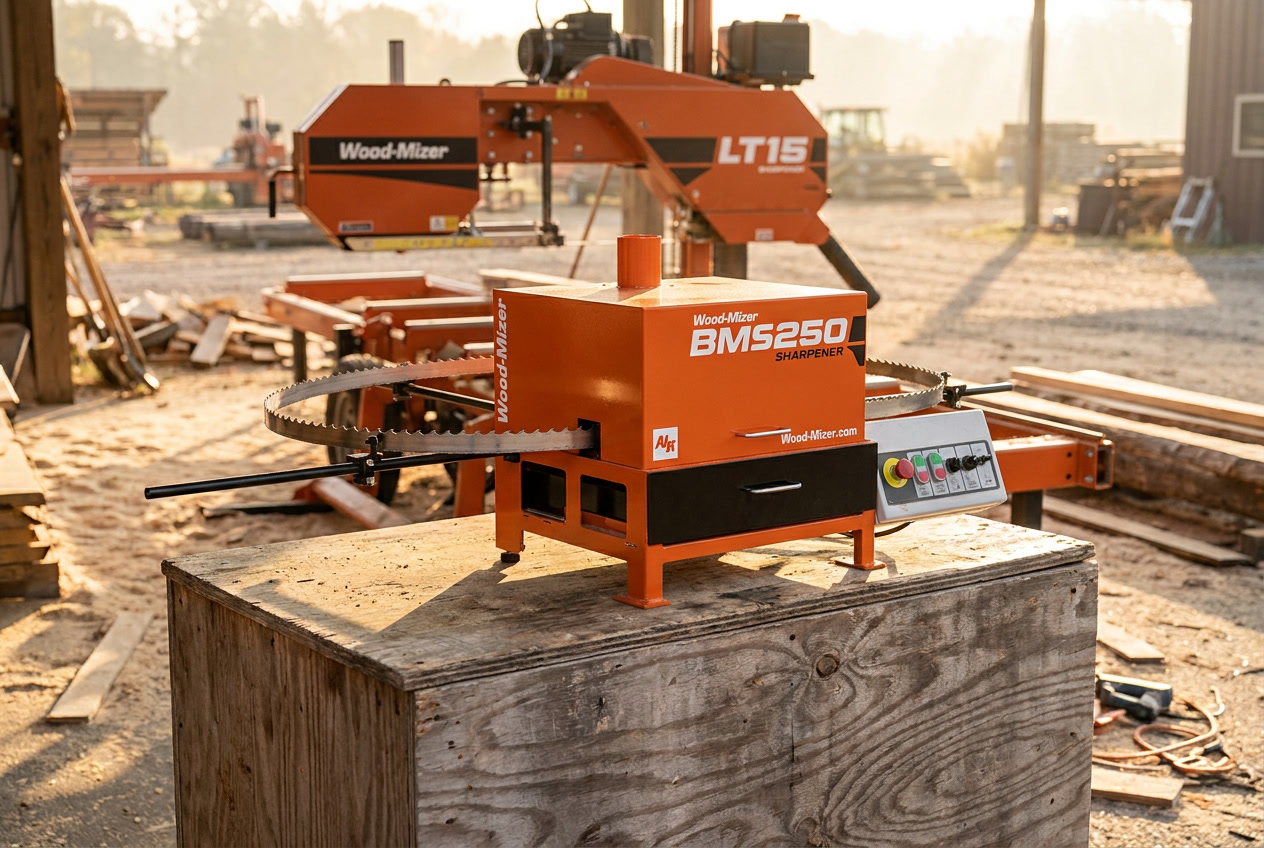
Then there’s the stuff Wood-Mizer doesn’t sell you: a cant hook — ours is a 60″ aluminum LogRite that grips 10″ to 36″ logs, which covers anything the LT15 bed will hold, and this is the same one on Amazon if you want to see what it runs — a log arch or a tractor with forks, blade lube, and either a sharpener/setter or a relationship with a sharpening service. Budget another $1,500–$4,000 depending on how you handle logs. Full price-tier context lives in how much a portable sawmill costs.
What We Like After a Decade on the LT15
- Thickness accuracy. The head crank scale in 1/16″ increments plus a rigid bed means a stack of 4/4 comes off consistent enough to go straight to the planer with minimal waste.
- Blade cost and availability. 158″ x 1 1/4″ x .042″ bands are the most common size in North America. You can buy them anywhere and get them sharpened anywhere.
- Belted 19″ wheels. Bigger wheels flex the band less. We routinely get more sharpenings per blade than operators running smaller-wheel mills. Blade care is where mills are won and lost — see our bandsaw mill blade guide.
- It’s fixable. Every wear part is a bolt-on. Parts are stocked in the U.S., and the phone gets answered by someone who’s run a mill.
- It holds value. Used LT15s sell fast. That’s real money if you ever step up.
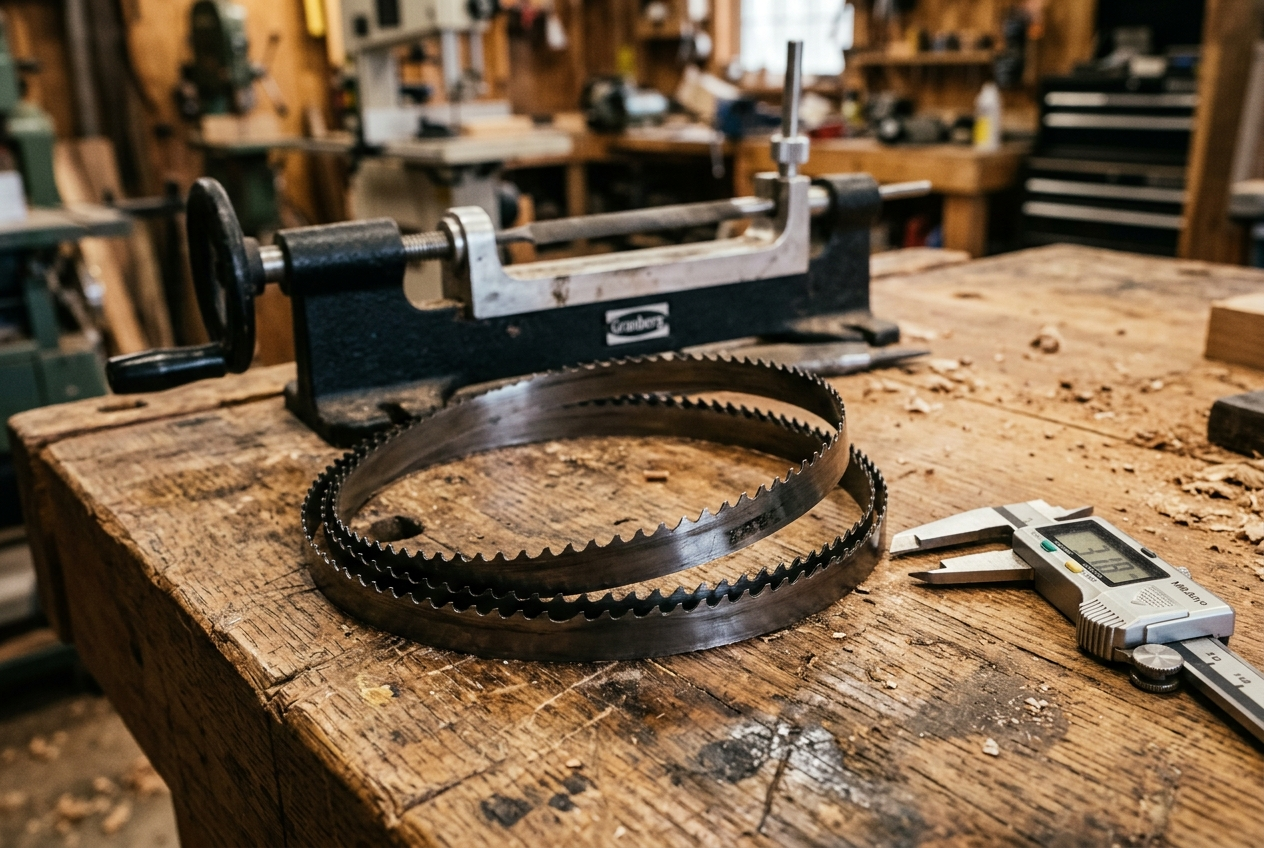
From experience: on a well set up LT15, about 1/32″ of variation across a stack is normal and not worth chasing. Once it opens up to 1/16″, something is actually wrong — and it is almost never the mill frame. We work it in this order:
- Fresh blade. Swap it before touching anything else. A dull or nicked band is the first suspect every time.
- Blade tension. Bring it back up to spec.
- Slow the feed. Pushing too hard makes a good blade wander.
- Blade guides and rollers. Check for wear and position.
- Belt tension. A slipping drive belt shows up as inconsistent thickness.
- Alignment and the bed. Last, not first — and rarely the answer.
Where the LT15 Falls Short
- Everything is manual. Push the head, crank the head, clamp the log, roll the log. The first time we sawed a 28″ red oak butt log solo, we were done for the day after three logs — not because the mill quit, but because we had.
- No setworks. You set every board thickness by reading a scale. It works, it’s accurate, and it’s slower than any mill with digital setworks.
- Manual blade lube. The 5-gallon tank and hand valve do the job, but there’s no auto-on. Forget it in a gummy pine and you’ll be scraping the band.
- Log handling isn’t included. The 4,000 lb bed rating is meaningless if you have no way to get a 4,000 lb log onto it.
- Published capacity is inconsistent. Wood-Mizer’s own LT15 page lists 32″ max log diameter in the spec table but 28″ in the page summary. Confirm the number with a dealer against the exact configuration you’re ordering.
LT15 vs LT35: The Line Where You Should Spend More
The LT35 hydraulic runs roughly $33,000 and up. That’s three LT15s. What you get is hydraulic log loading, a hydraulic turner, hydraulic toeboards and clamp, plus setworks — the four things that make the LT15 tiring.
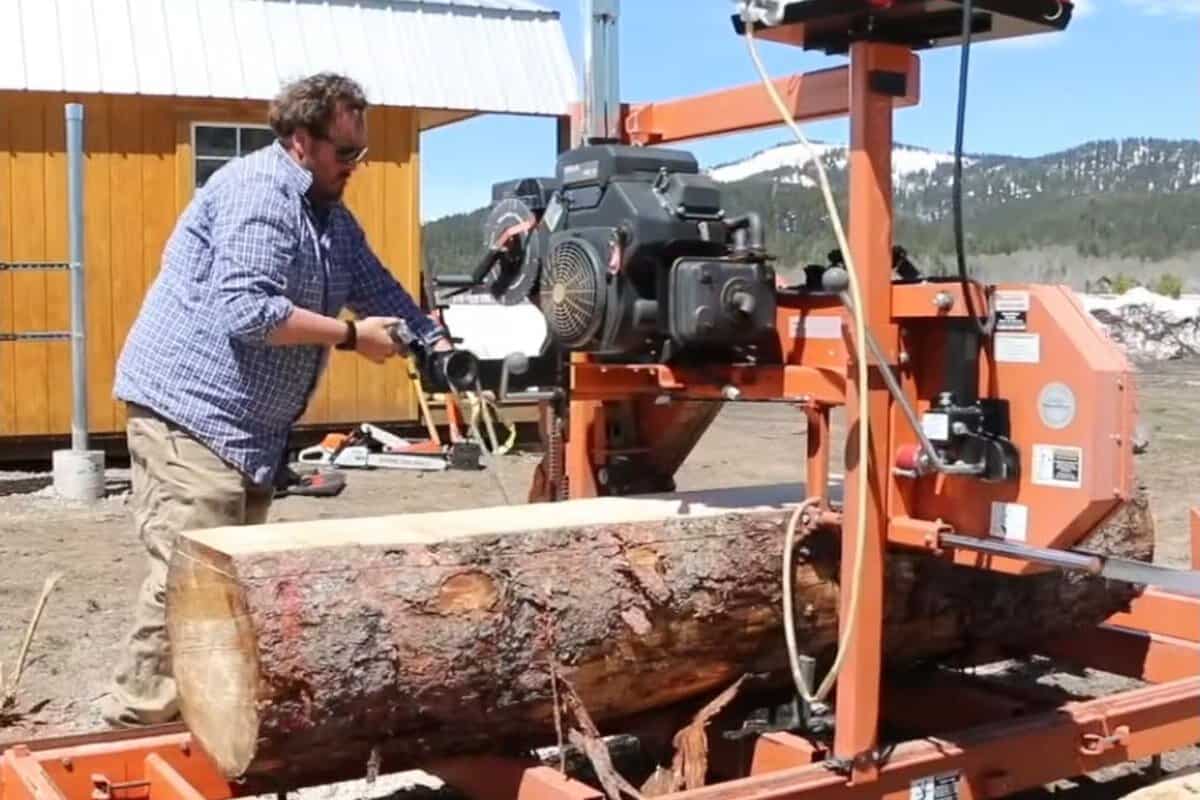
Here’s the operator rule we use: if you’re sawing more than about 20 hours a week for money, the LT35 pays for itself in throughput and in not destroying your back. Below that, the LT15 is the smarter buy and the extra $22,000 belongs in a kiln, a tractor, or dry inventory. Most people asking this question are hobbyists talking themselves into a professional mill. Buy the LT15, saw for two seasons, and let the mill tell you whether you’ve outgrown it. Our bandsaw mill operator’s handbook covers the technique that closes most of the speed gap.
Who Should Buy the LT15
Buy it if: you own timber or have steady log access, you want furniture-grade lumber, you’ll mill somewhere between 5,000 and 40,000 board feet a year, and you’d rather have accuracy than automation. Also buy it if you’re testing a custom-sawing business — the LT15 with a GO Trailer is the lowest-risk way to find out whether the phone rings.
Don’t buy it if: you’ll mill a dozen logs total (rent a sawyer or run a chainsaw mill), you need production income from day one (LT35), or you have back, shoulder or knee limitations that make hand-rolling logs a bad idea. There’s no shame in that last one — it’s the most common reason we see LT15s for sale after one season.
Wood-Mizer LT15: Frequently Asked Questions
Is the Wood-Mizer LT15 worth it?
Yes, for anyone milling regularly. At $10,895 it costs three to four times what a budget import mill does, but it holds thickness tolerance, uses cheap common blades, has U.S. parts support, and resells well. If you’ll cut more than about 5,000 board feet a year, the accuracy and the blade economics close the price gap quickly.
How big a log can an LT15 handle?
The standard LT15 takes logs up to 32″ in diameter and cuts up to 30″ wide, with a 23″ maximum cant width and 10 1/2″ depth of cut. The LT15WIDE steps that up to 41″ diameter and 39″ of cut. Bed capacity is 4,000 lbs, and 6′ 8″ bed extensions let you go past the stock 17′ 8″ log length indefinitely.
Is the power feed worth $1,495?
For most operators, yes — but not necessarily in year one. Hand-pushing the head is fine for a few logs and brutal for a full day. The 12V power feed is variable up to 90 feet per minute, and the consistent feed rate also improves surface finish because you stop unconsciously speeding up in easy wood. If cash is tight, start with the crank feed at $336 and add the power feed once you know you’re sawing seriously.
How much lumber can you actually cut in a day on an LT15?
Wood-Mizer rates it at up to 320 board feet per hour. In practice, one person working alone in hardwood does 100–150 BF/hr all-in; with a helper and mechanical log handling, 200–250 BF/hr. A realistic solid day is 800–1,500 board feet.
What engine should I get on the LT15?
For upper-Midwest hardwood, the 25HP Kohler gas. The 19HP will cut oak and maple but you’ll feel it bog in wide cuts and you’ll saw slower to compensate. Choose the 10HP electric only if the mill lives under a roof with real power, and the diesels if fuel cost over thousands of hours matters more than up-front price.
The Bottom Line
The LT15 is not the fastest mill, the easiest mill, or the cheapest mill. It is the mill that turns a log pile into stacks of lumber you’d actually build furniture from, at a price a working person can justify, with a support network that will still be there in fifteen years. Ours has paid for itself several times over and it’s still cutting straight.
If you’re ready to price one, check current configurations and promotions at Wood-Mizer, and confirm capacity numbers with a dealer against your exact build. Then come read the operator’s handbook before your first log — it’ll save you a blade and a lot of firewood.
Written by Jason Lewis, who has operated portable sawmills for over ten years and runs a Wood-Mizer LT15 through upper-Midwest hardwoods. Prices reflect Wood-Mizer USA listings at the time of writing and change with promotions — verify before you buy.